Writing Process: Native American author Amy Krout-Horn – Seeking Sacred Space

My sincere gratitude to Donna W. Hill, author of The Heart of Applebutter Hill, for her invitation to participate in the Writing Process Blog Tour. She afforded me this opportunity, and then took her kindness and generosity a step further when she offered her own blog site as a home for my post. Donna’s goodness, like her talent, is limitless.
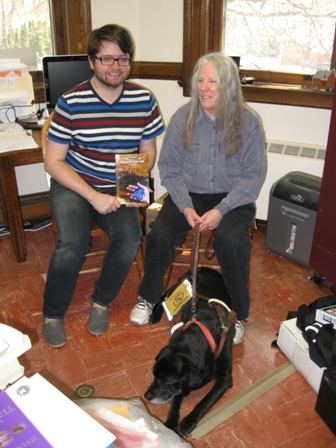
Donnna W. Hill  - with her black Lab guide dog, Hunter - donates The Heart of Applebutter Hill to Dir. Jesse Johnson of the Towanda Public Library: photo by Rich Hill

in her Writing Process Blog Tour post, Donna discusses transitioning between reality and fantasy as well as the social justice issues which motivate her. Read her post at: https://donnawhill.com/2014/06/16/writing-process-heart-applebutter-hill-author/  

The Heart of Applebutter Hill, an educator-recommended diversity, inclusion and anti-bullying YA fantasy novel, is available in print or Kindle at: http://www.amazon.com/books/dp/1483948226

Follow Donna on Twitter: @dewhill

The following are Amy’s answers to the four standard Writing Process Blog Tour questions.

What am I working on?
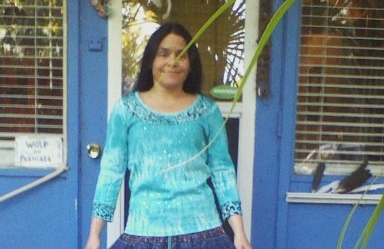
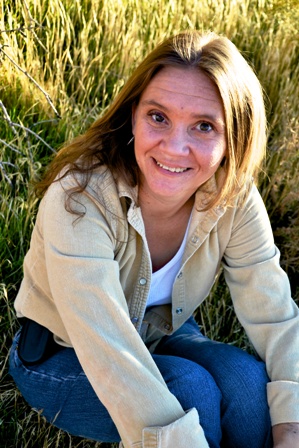
Native American author Amy Krout-Horn, author of My Father's Blood: photo courtesy of Gabriel Horn

I recently began to transition these persistent characters that were occupying both my waking and sleeping hours, from my head to my hard drive. Their stories are rapidly evolving into my fourth novel. I have an odd little working title for it, which may or may not stick, so I’ll keep it under wraps for now. However, since I’m a big fan of titled chapters, the completed ones are named and because I went all super-secretive on the working title, the least I can do is to say that Chapter One is called “Exotic Flowers of Fargo”. This latest project will focus on multi-racial characters removed from their Native American culture, either by circumstance or by design, and the impact that can result from denial of one’s heritage.

Right now, I’m also in the process of querying literary agents in hopes of finding representation for my previous manuscript, Dancing in Concrete Moccasins, while availing myself of speaking engagements so that my published babies won’t feel neglected. There’s that delicate balance that all authors must have between the time they devote to creation and the time they devote to promotion. Like most artistic personality types, I prefer the former, but recognize the importance of writing’s business end, so I grit my teeth, take deep cleansing breaths, and just do it.

How does my work differ from others in its genre?

I do not write within a specific genre. I would say that the majority of my work, would be categorized as literary or multi-cultural fiction. I largely explore themes that involve the juxtaposition of Native American and modern American culture. I do this most often by placing my Native characters in the setting where the majority of Native people, including myself, reside today. I take them off reservations, out of the 19th century, and put them in urban American cities, where they not only face all the contemporary challenges of their non-Native neighbors, they must grapple with an environment that stands in harsh contrast to traditional Native values at every turn.

I also think that blindness has provided me with an acute awareness when it comes to tapping all the senses with my word choices. This is perhaps particularly true when I’m attempting to show my readers a story’s visual elements, which may seem counter-intuitive to some, but blind people often rely upon the visual descriptions of others to experience and fully function within the real world. When I am weaving words into fiction, I think of all its future readers as blind, regardless of their actual visual acuity. Based upon that logic, I consider how the right word combinations have served my needs, both inside and outside of books, and then I strive to depict people, places, things, and sometimes, even thoughts and feelings, with enough descriptive power that all may “see”.

Why do I write what I do?

A strong commitment to my Native American (Lakota) ancestry guides me, and because this cultural connection lives at the very core of my being, there is nothing about which I am more passionate. I write fiction because I think it is a wonderful delivery system for fact, and when I include actual historical, cultural, and philosophical information, threading it through my fictional characters’ lives, I feel as if I’ve delivered something educational hidden in the pockets of something entertaining. Because type 1 diabetes and blindness have also played a huge role in shaping who I am and how I view the world, they often come through as aspects of my characters and their conflicts, too. It’s always said that writers should “write what you know,” and these are, through experience, observation, and study, the things that I know best. These are the sparks that, along with writing itself, light the fires in my belly. I think that, for me, the act of releasing the stories onto paper, is tending those fires; not letting them smolder out, while at the same time, keeping the flames from consuming me.

How does my writing process work?
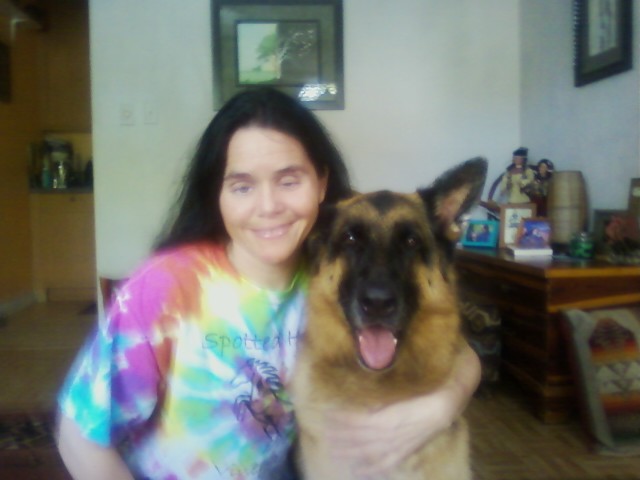
Amy Krout-Horn, blind Native American author of My Father's Blood, and her German Shepherd Bella: photo by Gabriel Horn

Creation is a sacred act and because I see it as such, I approach writing in a somewhat ritualistic manner. Morning is my favorite part of the day and my life partner Gabriel, our German Shepard Bella, and I walk every dawn, usually just around the time the sun is breaking the horizon. We go a couple of miles along the bay, meet up with neighborhood human and dog friends, greet the same water birds, hawks, and parrots that we have seen each morning for over a decade, and, of course, as would be expected from a couple of strolling authors, Gabe and I talk “writing”. It’s a time to share what we’ve worked on the previous day and discuss new ideas we plan to pursue, while drawing upon all the natural beauty that surrounds us. This beauty not only purifies the mind and energizes the senses, it often later becomes our stories’ settings, descriptions, and motivation. There is a certain place along a stretch of seawall, where Bella stops every day and sits to look out over the water, watching for dolphins. We cop a squat on either side of her and this is the point at which Gabe will ask, “Dream anything last night?”

I’m a life-long, Technicolor, five part mini-series, elaborate plotline kind of dreamer, so the question usually yields some juicy tidbits to feed into the mouth of one of our writing projects. Back home, after one, two, three cups of coffee, I retreat to our shared home office. It’s a small room, but Gabe and I manage to work peaceably together from our separate corners. It is our sacred space and we have filled it with those special things that remind us of why we write, inspire a feeling of serenity, and let our minds ripen with possibilities. Favorite paintings, family photos, diplomas, awards, and a small cross-stitched plaque; a gift from a former creative writing student, adorn the coral colored walls. On the shelves above my desk, I keep the polished stones that once belonged to my great grandmother, small carvings of owls, buffalo, wolves, and a black bear, and a medicine bag. At those moments, when I am flailing, searching for the words that will deliver the greatest clarity, and I’m feeling that I alone, can not move my meaning forward on the page, I pick one of these objects, hold it in my hand, appreciate its shape, its design, its symbolism, and I remember the person or the moment that granted me the particular gift. In this simple gesture, I often find the elusive line I need to pull me forward.

All of my projects begin with a central idea, but I’ve never sat down with an entire book or even an entire short story, for that matter, bouncing around inside my head. Because of this, you won’t find piles of index cards with Braille notes that contain character sketches or plotlines or complicated fictitious family trees, scattered on my desk top. I start every new project with the faith that the story will unfold if I put myself in the chair, lay my fingers on the keys, and let my mind open to whatever enters that sacred space.

I’m rarely a night writer, so I reserve evenings for reading. I’m a firm believer in the notion that a good writer must be an avid reader; therefore, I view my time spent with other authors’ books as just another part of my writing process. I have this split-brained approach when it comes to experiencing a book: part of my brain is just in it for the pure joy of it, the other lasers in on technique and flow and word choice and interesting descriptions and powerful uses of dialogue and all those other groovy elements that trip writers’ triggers. If only I could write novels as quickly as I read them…now that would be an impressive process.

For more about Amy Krout-Horn and her books: http://www.nativeearthwords.com

Next Monday’s Writing Process Tour: Amber Hart, author of Before You

Amber Hart grew up in Orlando, Florida and Atlanta, Georgia. She now resides on the Florida coastline with family. When unable to find a book, she can be found writing, daydreaming, or with her toes in the sand. She’s the author of Before You, After Us, Until You Find Me, and sequel to Until You Find Me (untitled as of yet). She’s represented by Beth Miller of Writers House.

Catch Amber’s Writing Process Blog Tour post next week at: http://www.amberhartbooks.com

Follow Amber on Twitter: @AmberHartBooks
Posted in Blindness, diabetes, Native American, nature, novel, Uncategorized, Visually Impaired, Wrighting | Tagged , , , , , , , , , , , | Leave a comment

Writing Process: Phyllis Campbell – author of Out of the Night, a Supernatural Mystery

Many thanks to Donna W. Hill for inviting me to take part in the Writing Process BLOG tour. Donna is a singer-songwriter turned novelist and an advocate for equality for people with visual impairments. Her debut novel, The Heart of Applebutter Hill is available in print or Kindle at: http://www.amazon.com/books/dp/1483948226

Visit Donna’s website & sign up to follow her blog at: http://DonnaWHill.com

Follow her on Twitter: @dewhill

These are my answers to the four standard Writing Process Blog Tour questions.

What are you working on now?

I have just completed, and published, Out Of The Night, a supernatural mystery. It is the story of two women, two centuries, and one man who is determined to destroy them, even from the grave.

How does your work differ from others of its genre?

Much has been written about the lot of women in the 1800s, but little, if anything, has been written about the lot of blind women during that period. If the lot of most women, even those married to wealthy men was bad, according to our standards, women without sight were often treated as things, less than human.

I have kept the tone light, however, because I want to hold the reader’s attention while telling a good story, as well as making what might be called a social statement.

Most plots in popular fiction bear many of the same elements, and Out Of The Night is no exception. It is made up of mystery, fear, pathos, and a touch of drama and romance, served up with a different twist.

The spirits must be heard, not seen, and sensed. Descriptions of common things such as the size of a room are different, consisting of echo or the feeling of space.

Why do you write what you do?

We are told, “Write what you know,” and while I do sometimes write through the eyes of someone who can see, my writing is usually made up of the things in my world, the world of a woman who is blind.

I want others to know that world, and in my writing experience of over fifty years, I have learned that a point of view can be made more through fiction. Many people wouldn’t be caught dead reading nonfiction, but give them a character they can identify with, and they start to think.

Easy? Decidedly not, but a rewarding challenge. I must take the reader into a new dimension where he/she has never been before, a world made up of touch, hearing, smell, and that mysterious thing called the sixth sense. I must make them feel the joy of the sun on their faces, the sense of uneasiness just before a storm, the quickened heartbeat at a sound in the night. The reader must be made to hear the drip of water in the underground room, smell the damp stale air, shut in for years. I must do this in such a way that he can go on to imagine the cobwebs festooning the ceiling, and the scattering of the bones of a long dead small animal. Yes, I can have the protagonist and the reader step on those bones with a brittle crunch. Rather than seeing eyes staring out of the darkness, the sound of a rat gnawing off to the side is more effective.

How does your writing process work?

Small things often spark my “what if.” Sometimes I may play around with an idea for months, even years, before it becomes a plot. Often the idea may be as simple as a grand piano in a used furniture store, or the voice of a child at a funeral. They may be something sad or disturbing such as a child lost for years, or a child’s death due to carelessness at a facility for disabled children.

I’m wary of “Here’s a great idea for you!” although my first book idea was conceived by an editor. Would I have written the book just to please her? Probably not, unless it grabbed my imagination, simply because I couldn’t have made it work. If, however, she had given me an outline, I would have followed it, but never been satisfied with the work.

Nonfiction is a different thing. If I’m assigned a nonfiction piece I don’t need to feel that sense of kinship with the work.

I usually plot fiction with a beginning, what’s happening; an end, where is it going; and the middle, how is it going to get there. Do I usually stick to this rough outline? Absolutely not! This would take the creativity out of the project, and I’d be left with a shell of a story.

The hardest part of the writing process is the rewriting, but make no mistake, it is essential. An editor told me that although several people may go over a manuscript, they sometimes miss mistakes. Some of my best writing has been done during a rewrite.

In closing all writers need to find their own writing identity, and go for it.

Out of the Night by Phyllis Campbell is available in multiple Ebook formats fromSmashwords: https://www.smashwords.com/books/view/405450

It’s also available from Amazon at: http://www.amazon.com/books/dp/B00IA04IXW

Posted in Uncategorized | 5 Comments

Writing Process: The Heart of Applebutter Hill Author Weaves Fantasy & Reality

Many thanks to Utah novelist Traci McDonald for inviting me to participate in the Writing Process Blog Tour. Traci is the author of the romance novel Killing Casanova (Crimson Romance 2012). Her follow up novel Burning Bridger is in the works.

Traci McDonald, author of romance novel Killing Casanova: photo courtesy of Traci McDonald

Traci, who has been blind for eighteen years, began writing full time after recovering from a kidney transplant in 2009. She credits modern technology and good training with enabling her to enjoy all facets of being a mother, music lover, reader, writer, and a history enthusiast.

Traci’s contribution to the Writing Process Blog tour features her philosophy about writing clean romance. Read her June 9, 2014 blog at: http://www.tracimcdonald.blogspot.com

Purchase Killing Casanova at: http://www.amazon.com/Killing-Casanova-Crimson-Romance-McDonald-ebook/dp/B008DVPAW6

Follow her on Twitter: @Tracimcauthor

After my answers to the four standard questions, I will introduce the authors who will be participating in next week’s Writing Process Blog Tour

What are you working on?

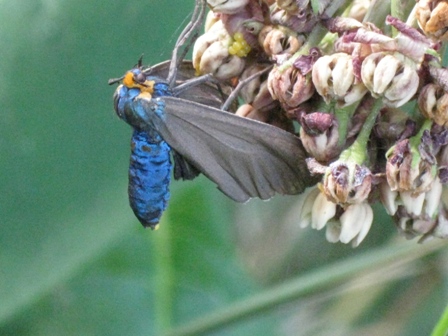
Blue butterfly on Milkweed: photo by Rich Hill

The Autumn Butterfly, next in the Applebutter Hill series, follows 14-year-old refugees Abigail and Baggy as summer ends and they head back to school. They soon learn that they aren’t the only ones who know about the powerful but unwieldy Heartstone of Arden-Goth.

The title refers to the “aki no choo” (Japanese for autumn butterfly(, a small crystal ball containing a blue butterfly with a pink heart on one wing. The crystal is cut so that the butterfly appears to move. In The Heart of Applebutter Hill, Rutherford tells them to carry one at all times. Can it help them escape from the growing band of power-hungry people interested in acquiring the Heartstone at any cost?

The bulk of my time, however, is spent trying to advance diversity in Young Adult literature. Abigail is losing her sight and has a guide dog named Curly Connor. Promoting the book to the public, as well as the diverse and scattered population of visually impaired people and professionals who could use it to advance social justice (especially for blind girls and women), is a more than fulltime job. Sometimes, I just have to stop myself and succumb to the awkward metamorphosis that transforms me from the marketer/promoter to the fiction writer, the one who started this whole thing in the first place.

How does your work differ from others of its genre?

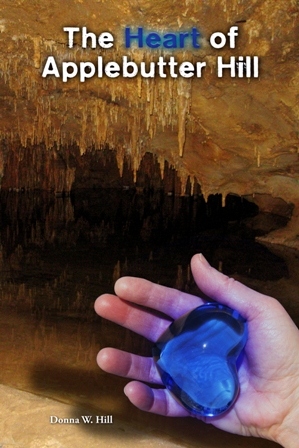
The Heart of Applebutter Hill book cover shows a cave scene - stalactites reflected in an underground lake, while a hand holds the Heartstone of Arden-Goth: photos, Rich Hill;, design, Lizza Studios.

The Heart of Applebutter Hill is commercially classified as either a Young Adult novel or a fantasy. I, however, think of it as “a high school adventure-mystery with excursions into fantasy for general audiences.” Although the setting is fictional, most of the book takes place in a realistic environment. Making seamless transitions between reality and fantasy is one of the great challenges and joys of my writing process.

What really sets The Heart of Applebutter Hill apart, however, is the way in which it portrays a member of the most marginalized minority — people with visual impairments. Most YA novels featuring blind girls focus on the acceptance of blindness or the transition to the use of nonvisual adaptations, such as Braille and text-to-speech software. Abigail, although she is learning these skills, is primarily involved with her best friend, photographer and mechanic Baggy, and the secrets they discover in the course of their adventures. Abigail’s blindness is not dwelled upon, and it’s not ignored.

Why do you write what you do?

I was bitten by the publishing bug when my four-line poem was published in elementary school. I spent twenty years as a self-promoted singer-songwriter/recording artist, presenting programs about blindness and motivation for k-12 schools.

I’ve also written articles for print and online publications about blindness issues, including the Braille literacy crisis and the lack of accessible classroom materials, websites and so on. For five years I volunteered as a publicist for the National Federation of the Blind and placed stories about exceptional blind people with newspapers and other media.

I am motivated because beautiful young people with intelligence, talent and grit are still forced to fight the battle of their lives for inclusion in a world that too often dismisses them as incapable of making valuable contributions. Public ignorance, fear and pity result in unnecessary roadblocks such as low expectations, a lack of accessible books, web and software designers who fail to build in the 1s and 0s which would make their sites accessible to people using screen readers and a general atmosphere of shunning and bullying.

I’ve sung about it, spoken about it, written articles and memoirs about it and now I’m using fiction to try to break through the social stigma. By giving readers an exciting adventure featuring a fully-fleshed character with skills and flaws, dreams and nightmares, I hope to play a part in awakening the sighted world to our common humanity.

How does your writing process work?

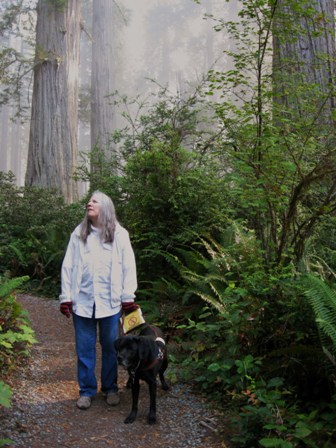
Donna W. Hill, author of YA fantasy The Heart of Applebutter Hill, & her guide dog Hunter on path in Redwoods with a glowing mist: Photo by Rich Hill

My main characters, Abigail, Baggy and Curly Connor are reality-based and had been floating around in my mind for many years prior to my knowing how to tell their stories. I like to experience a story in my head before committing it to words. I walked in the fictional town of Applebutter Hill and mapped it out in my imagination. There was a lot to make up between the school, the carriage house and the old Victorian where Abigail and her guardian live. Then, there was Abigail’s trip to the mountains to visit Baggy.

Similarly, I imagined in detail the settings in the fantasy world, such as the Castle of Bar Gundoom and the land of Satori Green. The innermost domed courtyard of the Castle of Bar Gundoom is an ultra-embellishment of the “Finger Bowl” at the Grey Towers National Historic Site (Milford, Pennsylvania). Grey Towers is the ancestral home of Pennsylvania Governor Gifford Pinchot (1865 – 1946), founder of the USDA Forest Service.

I also invented the Cloud Scooper and the virtual reality classroom called the Nickel Room. I need to know all of these settings thoroughly. In addition to providing material for the book, an intimate acquaintance with the setting enables me to live and learn there, keeping my focus inside the novel’s internal reality.

I worked out the back-stories for the characters and the Heartstone and set up a calendar to outline the various plot threads. The Heartstone was inspired by a passage in C.S. Lewis’s The Silver Chair. Many of the incidents in the book were taken from my own experiences.

My philosophy about fiction writing is that it is like journalism. You get the details of the story, confirm them, write them down and start editing.

next week: Phyllis Campbell, author of Out of the Night & Amy Krout-Horn, author of My Father’s Blood

Next Monday, it will be my pleasure to host two extraordinary authors.

Phyllis Campbell:

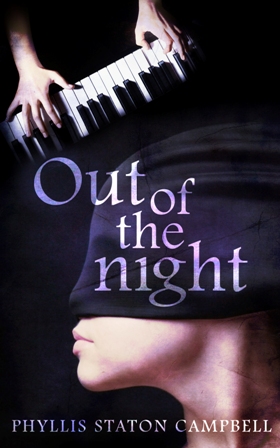
Out of the Night, a suspense novel by Phyllis Campbell, book cover

Phyllis Campbell, author of the new suspense novel Out of the Night (2014), has been writing since the ’60s. Her first novel was Come Home My Heart (Avalon Books, 1986). Friendships In The Dark (Brett Books, 1996), her memoir about growing up blind, was picked up by St. Martin’s Press (1997) and translated into Chinese (Sea Breeze, China, 1998. Who Will Hear Them Cry? and A Place to Belong were self-published in 2012.

Out of the Night is a gripping tale of two women, two centuries, and one man determined to destroy them even from the grave. Chris has faced many challenges in her twenty-one years of life — a mother more involved with her career than with her daughter, a father who deserted his family also to pursue a career, and the loss of her sight. Nothing, however, has prepared her for the challenge faced by her and the four other clients attending an independence center held in a historic building on the campus of the school for the blind.

Phyllis, who writes two bi-monthly columns for the Our Special magazine (National Braille Press), serves as organist at Faith Lutheran Church in historic down town Staunton, Virginia. She teaches piano and voice, specializing in Braille music.

Born in Amherst County, Virginia, Phyllis moved to Staunton at age seven. She is a graduate of The Virginia School For The Deaf and The Blind, and went on to study at Lynchburg College in Lynchburg, Virginia, and Dunsmore Business College in Staunton. She took further courses from the Hadley School For The Blind (Winnetka, Illinois). in 1989, she received their Lifelong Learning Award. She has worked as a music teacher, peer counselor, computer tutor, and as Youth Transition Coordinator.

Pick up your favorite electronic version of Out of the Night from Smashwords – available e-versions include .mobi (Kindle), .epub (Apple, Nook, Sony, etc.), .pdf and .rtf (accessible for readers with print disabilities): https://www.smashwords.com/books/view/405450

Or, find it on Amazon at: http://www.amazon.com/Out-The-Night-Phyllis-Campbell-ebook/dp/B00IA04IXW

Be sure to catch Phyllis’s Writing Process Blog Tour contribution right here next Monday at: http://DonnaWHill.com

Amy Krout-Horn

Amy Krout-Horn, blind author of the autobiographical novel My Father's Blood, and her German Shepherd, Bella: photo courtesy of Amy Krout-Horn

Amy Krout-Horn, Oieihake Win (Last Word Woman) has resided in two worlds; the world of the sighted and the world of the blind. She has been a writer in both of them. She is the co-author of Transcendence (All Things That Matter Press 2009), which received the National Indie Excellence Award 2012 for visionary fiction. Treat yourself to the audio version: http://www.audible.com.au/pd/Fiction/Transcendence-Audiobook/B00FOBT2CW

She is also the author of the highly-praised autobiographical novel, My Father’s Blood (All Things That Matter Press 2011). Pick up a copy At: http://www.amazon.com/My-Fathers-Blood-Amy-Krout-Horn/dp/0984639292

Her work is included in the anthology, Unraveling the Spreading Cloth of Time: Indigenous Thoughts Concerning the Universe (Renegade Planets Publishing 2013).

Amy, whose ancestry is Lakota, worked as the first blind teaching assistant at the University of Minnesota’s American Indian Studies program. A staunch advocate for social and environmental justice, she writes and lectures on native history and culture, diabetes and disability, and humanity’s connection and commitment to the natural world. For more information, visit her web site at: http://www.nativeearthwords.com

Be sure to catch Amy’s Writing Process Blog Tour contribution right here next Monday at: http://DonnaWHill.com

Posted in Blindness, Self-Publishing, Visually Impaired, Wrighting, young adult | Tagged , , , , , , , , , , , , , , , , , , , | Leave a comment

Stray Cat & Working Dog: Abandonment, Rescue & Redemption in the Middle of Nowhere

double rainbow on the butte at Wyoming's Fossil Butte National Monument: photo by john collins, courtesy of the National Park Service

According to an evolutionary time-line exhibit at Wyoming’s Fossil Butte National Monument, dogs and cats shared a common ancestry until 42 million years ago. Factions from both groups ultimately took the plunge into domestication, so what drove them apart to begin with?

An Explanation

My musings on this subject are rooted in the reference to “42.” As a fan of the late British sci-fi writer and satirist Douglas Adams (1952 – 2001), I treasure any mention of the number. Actually, I’m obsessed with it. The first paragraph in this article, for instance, contains 42 words, but that was an accident. Wasn’t it?

In Adams’ Hitchhiker’s Guide to the Galaxy, a BBC radio production turned into a ‘trilogy’ of ‘five’ novels, “42” turns out to be the answer to “life, the universe and everything.” I collect such references, and wrote an article in homage to Adams in 2009. He has yet to properly thank me for it … unless, of course, it was he who sent the cat.

Cats and Dogs: Irreconcilable Differences?

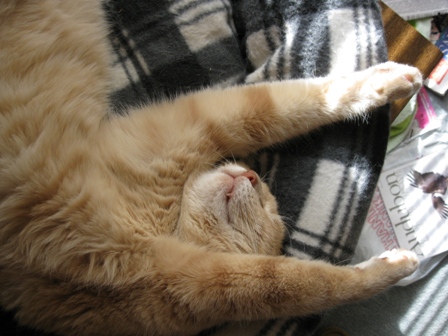
Goofus, a male, Strawberry-blonde tabby, hangs upside-down in the family room: photo by Rich Hill

My interest in cats and dogs and their relationships with us and each other comes from a lifetime of living with dogs and a good little while of living with one particular cat named Goofus.

Some rifts in the ancestral dog-cat community seem painfully obvious — especially from the cat’s perspective. Grace, for instance, though not entirely lacking in the canine, reaches the level of an art-form in felines.

Some dog-cat predecessors preferred a unilateral gait, both right legs stepping forward together and vice versa. Others — “plodders and klutzes,” as our cat would call them — adopted a bilateral gait — right front and left rear. Humans do this with our arms, a point which pretty much seals the inferiority of it in the cat’s view.

Then, there’s the collarbone. Humans and canines apparently agreed on this one also.

“Yes, of course we want collarbones; see how big and strong they make our shoulders look?”

We might assume that the cat would have taken the plunge into vanity on this point, but for the cat, survival is the most attractive thing on the menu. Proto-cat valued the ability to squeeze through narrow spots — a feat which is compromised when the limitation is the width of your shoulders and not your head. Cats have “floating” collarbones, buried in their shoulder muscles.

Several other features ensure the feline’s survival. Sensitive and functional whiskers, adjustable and independent ears, and elliptical pupils make hunting at night a viable option. The dog yawns and wonders why anyone would want to go out at night, when everyone’s sleeping.

Hunter, an 11-year-old black Lab, is looking out from his bed under the table: photo by Rich Hill

There is also the whole “sniffing the butt” ritual. Though it is one of the canine’s greatest pleasures, it remains unseemly to the feline. The cat is also offended by the whole obedience thing. Tolerating the propensity of the dog to throw all dignity to the wind for the sake of trifles is, as I am assured, one of the thankless burdens of being a cat.

“And those tales! You look like you’re being followed by an invisible oscillating fan. Is that why you chase them? Just trying to get them to slow down?”

Animal Abandonment & Rescue

Despite the cat’s self-proclaimed superiority, it was the dog who saved the cat, at least in our lives. According to the ASPCA, a pet is beaten or neglected every 60 seconds.
One such victim was a six-month-old strawberry-blonde, neutered male tabby, who was dropped off in the middle of nowhere in the summer of 2010. With shelters filled to capacity during the recession and embarrassment no small factor, many animals were abandoned along rural roads to survive or die by their own wits.

The middle of nowhere is where we live. The first thing we noticed was a beautiful cat watching Rich from afar as he worked in the barn, on the vehicles and preparing firewood for the upcoming winter. His coat was so thick and luxurious that we assumed he had a home. Then, as I walked our trails with Hunter, my black Lab guide dog, I heard a small animal following us.

“These rabbits are getting really brazen,” I thought, but it wasn’t a rabbit. It wasn’t a squirrel either.

One night, with a stone wall between us, he talked to me, and I was smitten. As winter approached, he started hanging around more often. We began suspecting that he was a stray. We didn’t really want a cat. I was allergic, and how fair would it be to Hunter to bring an interloper into our little family?

Donna & her guide dog Hunter walk along path in Redwoods. There's a glowing mist: Photo by Rich Hill

We put food out for him, and somebody ate it. Toward the end of November as the temperatures dipped below freezing, he approached Hunter and me with the most mournful and urgent tale. Animals don’t generally want anything to do with me. They must see that I have one of their kind in harness and don’t want to risk a similar fate. But, this cat was desperate and, in all fairness to his dignity, he had been vetting us for months.

The Reality of Goofus

When we finally got our hands on him, we realized that he was all skin and bones, infested with worms and covered in ticks. We thought he had been declawed; even when Rich spread his toes, he could see nothing resembling a claw.

“We’ll just get him cleaned up and healthy. Then we’ll give him to the shelter.”

Yeah, right. Our local Humane Society is a “no kill” shelter, and they were full. By the time they had room, we loved him, and Hunter decided that kitty could stay.

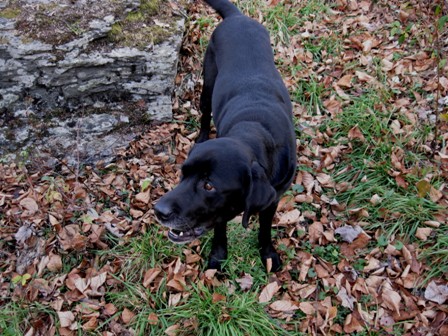
Hunter, Donna's guide dog, rests in autumn leaves: photo by Rich Hill

“He’s OK; he’s just a little trouble.”

We supplemented his food with homemade turkey breast. We got him a litter box, which he refused to use. Having spent so much of his short life outdoors, he wasn’t comfortable staying inside. For months, he continually flexed his claws, trying to get his strength back. As his health returned, he began shunning human food, running to leave the house whenever we showed the slightest inclination to eat.
Goofus became a skilled hunter, ridding our barn of mice. And my allergies? Not an issue; he smells like the great outdoors.

Cat and Dog: Brothers and Friends

Goofus maintains a curiosity about Hunter’s diet. He is allowed to stick his head in the bowl while his brother eats. More amazing than Hunter’s tolerance is that Goofus, who is fastidious to the extreme, is willing to risk being pelted with bits of flying food and that Hunter, who enjoys the stereotypical Labrador fondness for anything remotely edible, never touches kitty’s food.

Hunter likes to run up to whatever chair Goofus is in and smash his snoot into him, sneezing and slobbering. Goofus, who is still wary of most dogs and humans, accepts these overtures without hesitation or complaint. They head-butt and sprawl on the floor together, and they keep each other’s confidences.

Many times, when I can’t find kitty, I have asked Hunter to find him. Hunter, who dug my glove out of a foot of snow and who comes running at the sound of me dropping anything, will not show me where Goofus is.

Only once did he break from this policy. Goofus had been gone for three days. We were convinced we’d lost him. One evening after lots of tears, I took Hunter out for a break. In a last-ditch effort I said, “Can’t you find kitty for Mama?”
He led me into the high grass where I found a cowering, but otherwise unharmed Goofus, who allowed himself to be scooped up into my arms and returned to the house. He’d probably been treed by a neighbor’s dog.

Nowadays, Goofus spends most of his time in our laps or at least keeping our chairs warm. My knitting is out in the open all over the house, and he never touches it. He still enjoys accompanying us on our last walk of the evening. In summer, he escorts us to the door and then peels off into the night.

Dogs and Cats in The Heart of Applebutter Hill

Goofus, the strawberry-blonde, male tabby sits with a copy of The Heart of Applebutter Hill. His paw is covering the author's/his mother's name: photo by Rich Hill

Curly Connor, half black Lab and half Golden Retriever, and Emmett, a rescued orange tabby kitten, each play a prominent role in my novel, The Heart of Applebutter Hill. Curly Connor works as a guide dog for the fourteen-year-old heroine Abigail, a shy singer-songwriter.

The Fluffer-Noodle, as she often called him, was over two years old and had long since developed specific ideas about how things should be. When something was not to his liking, Abigail and her best friend Baggy Brichaz would say that it had “offended his delicate sensibilities,” and the prospect of spending a splendid May afternoon indoors was threatening to do just that. (The Heart of Applebutter Hill, Chapter 1)

Abigail and Baggy attend the Plumkettle Learning Center. Emmett shows up during the headmaster’s speech on the first day of the summer term.

Abigail, who was sitting midway back along the center aisle with Curly Connor at her feet, lost the thread of the headmaster’s speech as people around her began to whisper. Several girls a few rows ahead squealed, as one of them picked up the orange kitten that had been outside when they arrived. All over the auditorium, heads turned toward them.
“Ah, yes,” said Cinderbin back at his microphone, “You have discovered Emmett.” He paused as everyone looked toward the squealing girls. “Stand up, Miss Brown,” he said to the girl holding the purring kitten, “Emmett has adopted the Plumkettle Learning Center. He started showing up at Transition House a week ago. After they succumbed to feeding him several times, Mrs. Shafer and Mrs. Ervy thought it would be prudent to name him.” (The Heart of Applebutter Hill, Chapter 26)

While Curly Connor provides a glimpse into the working relationship between human and canine, Emmett’s role shows humanity’s dark side. He is targeted by a group of students who take more pleasure from hurting animals than loving them. Does Emmett survive? Come find out.

Free E-Version of The Heart of Applebutter Hill & a Chance to Win YA Fantasy in Print

The Heart of Applebutter Hill book cover shows a cave scene - stalactites reflected in an underground lake, while a hand holds the Heartstone of Arden-Goth: photos, Rich Hill;, design, Lizza Studios.

https://donnawhill.com/book-giveaway-sign-up-read-the-heart-of-applebutter-hill-for-free-and-help-promote-braille-literacy/

What Others are Saying About The Heart of Applebutter Hill

Donna - with her guide dog, Hunter - donates The Heart of Applebutter Hill to Dir. Jesse Johnson of the Towanda Library: photo by Rich Hill

“In a way, the tale acts as an all-encompassing guide to childhood, as it details the struggles of bullying, consumerism and being cast from society.”
1/1/14, Michael Wintermute, Wyoming County Press Examiner
‘Meshoppen author pens mystery novel’ http://wcexaminer.com/?p=39493 

“It was a great adventure story with likable, well-rounded characters with lots of different abilities and struggles — many of which kids rarely get to read about! My favorite was Curly Connor, not many writers write dogs this well! …”
10/22/13 Max Ray, Comments on homepage http://DonnaWHill.com

“Hill believes The Heart of Applebutter Hill will help sighted readers understand the reality of blindness as well as give blind youngsters a character with whom they can identify. Reviewers agree.

‘Hill has done a superb job conveying the impact of going blind, as her heroine finds refuge in music and fantasy,’ playwright Uke Jackson wrote.’

‘I believe Hill has a gem here,’ wrote University of Scranton professor emeritus Patricia Gross. ‘I particularly savored the poetry and songs that underlay the action.” “I believe Hill has a gem here,” wrote University of Scranton professor emeritus Patricia Gross. “I particularly savored the poetry and songs that underlay the action.'”
12/19/13, MARY THERESE BIEBEL, Wilkes-Barre Times-Leader
‘The biggest project of my life’ http://timesleader.com/news/features/1050744/The-biggest-project-of-my-life

“It was one of those books you sit down with and you blink and suddenly discover you’ve read 100 pages…”
2/17/14 Niffer’s Review, Goodreads https://www.goodreads.com/book/show/18153835-the-heart-of-applebutter-hill#other_reviews

“I had the pleasure of getting an early read on Donna’s book; I
still think about the characters, and especially the cloud ship!…”
3/18/13 RobertLeslie Newman Comments on homepage http://DonnaWHill.com

“This book had a mixture of realism and fantasy.
Something for everybody, young and old alike.”
4/24/14, Eileen Corman, Amazon Reviews http://www.amazon.com/The-Heart-Applebutter-Hill-ebook/dp/B00CNG6DDM 

“This book is a great read for young and old alike. Anyone interested in a fiction novel that combines fantasy with reality, humor and adventure, this is
for you. The detail of the imagination of the writer is evident at every turn of the story…”
12/29/13, Lisa E. Robinson, Amazon Reviews http://www.amazon.com/The-Heart-Applebutter-Hill-ebook/dp/B00CNG6DDM

“The amazing thing about the way Donna Hill has written this novel
is that it weaves the experience of a child who is blind into a novel that is engaging on its own. I think it is an excellent choice for parents who want
to provide a unique way to help their children avoid assumptions and stereotypes as they expand their view of diversity.”
3/29/14, B. Wentz, Amazon Reviews http://www.amazon.com/The-Heart-Applebutter-Hill-ebook/dp/B00CNG6DDM

“What I really enjoyed was that the character (who is blind) was portrayed
in a positive, competent way. A great addition to any school or home library.”
January 12, 2014, NW Reader, Amazon Reviews http://www.amazon.com/The-Heart-Applebutter-Hill-ebook/dp/B00CNG6DDM

Meet the Author of The Heart of Applebutter Hill

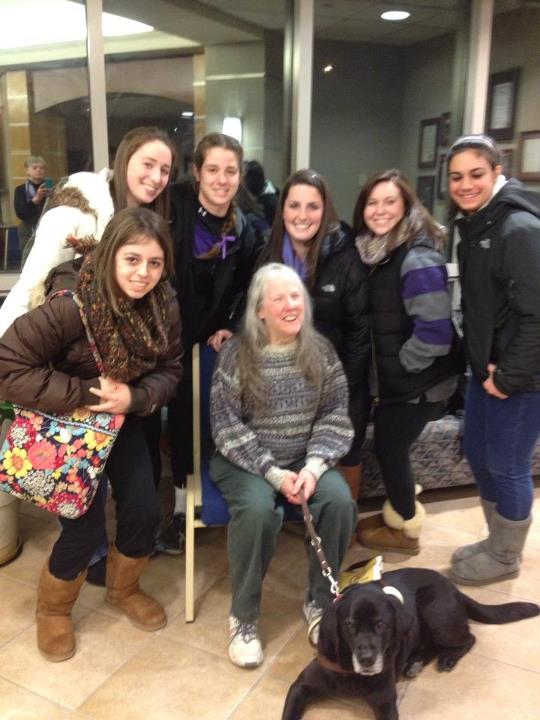
After workshop on the novel The Heart of Applebutter Hill & Blindness Issues, U. of Scranton Education Students Gather Around Donna & Hunter for a Photo Op: photo by ashley allegraInvite Donna W. Hill to be a guest speaker for workshops, seminars and classes. Topics include writing, songwriting, anti-bullying and mainstreaming students with visual impairments. Write to her using the “Contact” link on this page.

Also coming — contests and special features.

Accessibility Issues for People Using Screen Readers

Screen reader users, there are significant issues with Word Press’s “Leave a Reply” form – which is labeled on this site “So, What Do You Think?”Here’s a “temporary” solution. Every page and post now has a link labeled “Accessible Comment Form for Screen Reader Users.” It will be sent to me, and I will post it on your behalf. The URL is: https://donnawhill.com/accessible-comment-form-for-screen-reader-users-3

Posted in Cats & Dogs, Guide dogs, novel, Service Dogs, Wrighting | Tagged , , , , , , , , , , , , , , , , | 1 Comment

Support Braille literacy with $1.75 & This 75%-off Coupon!

It’s “Read an E-book Week” at Smashwords!

The heart of Applebutter Hill by Donna W. Hill is on sale. Get any e-book version for $1.75 now through midnight March 8, when you use coupon code REW75 at:http://www.smashwords.com/books/view/313071?ref=DonnaWHill

The Heart of Applebutter Hill, an adventure-mystery for general audiences, follows two 14-year-old refugees, Baggy & Abigail, as they find their way in a new land and learn a dangerous secret. Baggy is a photographer and mechanic, and Abigail is a shy singer-songwriter and travels with her guide dog Curly Connor (aka the Fluffer-Noodle.

Do you use an e-book reader or need a gift for someone who does? The Heart of Applebutter Hill is available at Smashwords in 7 e-book formats including .rtf or .pdf for reading on your computer, .epub (Apple, Blio, Nook, Sony, Kobo, etc.), and .mobi (Kindle): http://www.smashwords.com/books/view/313071?ref=DonnaWHill

Proceeds from sales Support Braille literacy.

Did you know?

  1. Readers with print handicaps like blindness and dyslexia have access to only 5% of the books out there.
  2. Only 10% of America’s blind children are taught to use the only tool that gives nonvisual readers true literacy on a par with print … Braille.
  3. 80% of the internet is inaccessible to people using text-to-speech software, despite the fact that the technology is both available and inexpensive.
  4. The Heart of Applebutter Hill received pre-publication recommendations from professionals in the fields of education, rehabilitation and the arts as a classroom resource for diversity-inclusivity and anti-bullying initiatives in middle school through college. Read their comments at: https://donnawhill.com/recommenders-of-the-heart-of-applebutter-hill/

Please help get The Heart of Applebutter Hill published in Braille, so teens with vision loss can see themselves in an exciting adventure for a change:http://www.smashwords.com/books/view/313071?ref=DonnaWHill

Reviews & More!

Please help spread the word any way you can. Take a few minutes to rate and review The Heart of Applebutter Hill on Smashwords and, if you have an account, on Amazon:http://www.amazon.com/books/dp/1483948226

Find out about print, e-book and accessible versions of The Heart of Applebutter Hill, and sign up for blog post announcements and upcoming contests at:http://DonnaWHill.com

Recent Articles about The Heart of Applebutter Hill

The Heart of Applebutter Hill book cover shows a cave scene; stalactites reflected in an underground lake, while a hand holds the Heartstone of Arden-Goth: Photos, Rich Hill; Design, Lizza Studios

12/19/13
Wilkes-Barre Times-Leader
“The biggest project of my life” by Mary Therese Biebel: http://timesleader.com/news/features/1050744/The-biggest-project-of-my-life

1/1/14
Wyoming County Press Examiner
“Meshoppen Author Pens Mystery Novel” by Michael Wintermute: http://wcexaminer.com/?p=39493

Author Bio

Donna sitting on an ice bench holding a copy of her novel The Heart of Applebutter Hill: photo by Rich Hill

Donna W. Hill is a writer, speaker and avid knitter from Pennsylvania’s Endless Mountains. A songwriter with three albums, she provided educational and motivational programs in the Greater Philadelphia area for fifteen years.

From 2009 through 2013, Hill was an online journalist for numerous publications, covering topics ranging from nature, health care, Braille literacy and accessibility to music, knitting and chocolate. As a volunteer publicist for the National Federation of the Blind, she has placed articles in newspapers and other media throughout the country about exceptional blind people and the social justice issues they face.

Hill’s articles have also appeared in the NFB’s Braille Monitor and in Slate & Style, the quarterly journal of the NFB’s Writers’ Division. Her essay, “Satori Green” appears in Richard Singer’s Now, Embracing the Present Moment (2010, O-Books), and her breast-cancer-survivor story is in Dawn Colclasure’s On the Wings of Pink Angels (2012).

Her memoir, “Special Class: a journey in mainstreaming” was selected for inclusion in Behind Our Eyes: a second look, an anthology of stories, poetry and memoirs by writers with disabilities: http://www.amazon.com/Behind-Our-Eyes-Second-Look/dp/1490304479/

Hill, who was born with Retinitis Pigmentosa, was the first legally blind child mainstreamed in her public school district. She is an experienced talk show guest and guest blogger. She presents workshops about her journey, her novel and the issues facing blind Americans for school, university, community and business groups:http://DonnaWHill.com

Posted in Accessibility, adventure-mystery, Education, fantasy, novel, Self-Publishing, Smashwords, songwriting, Wrighting, young adult | Tagged , , , , , , , , , , | Leave a comment

The Cave at Missing Creek: a Sample Chapter from the novel The Heart of Applebutter Hill by Donna W. Hill

Readers, here’s all you need to know: 14-year-old refugees Abigail & Baggy sneak away from summer fest to explore a cave, hoping to find the powerful Heartstone of Arden-Goth. Abigail has had a bad day; her new school’s newspaper faculty adviser rejected her application to be an apprentice. The reason? He doesn’t think she can do the work because she is losing her sight. Curly Connor, aka the Fluffer-Noodle, is her guide dog.

The Cave at Missing Creek

Cave scene from Donna W. Hill's novel, The Heart of Applebutter Hill, shows stalactites reflected in the underground lake in the cave at Missing Creek: photo by Rich Hill

Abigail and Baggy held hands as they walked around Village Square after school, the Fluffer-Noodle prancing beside them. Musicians were already performing from the gazebo, and merchants were setting up tables in front of their stores.

They waited in line at the crowded cheese shop and ate their sandwiches at an umbrella table outside. When Abigail fed Curly Connor, he pushed his bowl around the grass so enthusiastically, that several people laughed and cooed at him. Jack waved as he headed to Taker’s Café, carrying two guitars and talking excitedly with three other men lugging instruments and amps.

At sundown, they slipped away from the crowded square. Gabriele and Tommy were just arriving.

“Leaving so soon?” asked Tommy with a big smile.

“Gotta drop Curly Connor off at Transition House,” Baggy explained, “We’ll see you later.”

On the way down Darlington Avenue, Abigail was sullen and not speaking. Baggy knew that something was wrong. She had looked miserable during lunch and Survival 101, and had barely said a word all evening. His attempts to find out what was going on had been unsuccessful, but he thought once they were truly alone, he’d try again.

“What’s up?” he asked as they descended the path behind the stationery store.

“Nothing.”

“Are you having second thoughts?” he persisted, “The bats will be gone by the time we get there.”

“No, it’s not that.” She didn’t know how to explain about the newspaper staff meeting, but felt she had to say something, “Howard was absent and we had a substitute who gave us the weekly quiz. She wouldn’t let Beth read it to me without a signed affidavit from the headmaster.”

“Oh,” he said unconvinced.

“And, Mr. Howard forgot to tell me about the meeting of the newspaper staff.”

“Nice,” he said sarcastically.

Once inside Phesty’s tool shed, Baggy retrieved their bag of spelunking supplies. Brushing away the cobwebs, he extracted the rubber boots, and they pulled them on. Despite the uncomfortably warm and humid evening, they slipped into hooded sweatshirts and windbreakers.

“No point in zipping up yet,” he said, “Do you have your gloves?”

“In my pockets.”

He reviewed his mental checklist: high rubber boots, warm clothes, compass and flashlight. He had extra batteries, and they both had water and trail mix in their packs.

Leaving the shed, they walked toward the creek, and Baggy looked downstream. The odd fluctuation in the current, where the tiny stream flowed out from under the tangled thicket, rippled under streaks of light from the setting sun. Perhaps it was just the interplay of the long shadows with the rushing current, but it was unsettling to not have the Fluffer-Noodle with them.

As they approached the end of the gravel path, Baggy was growing ever more conscious of the other things they didn’t have. Most importantly, no one knew where they were. They had told everyone that they were attending Summer Fest.

Abigail had asked Mrs. Shafer to watch the Fluffer-Noodle, saying that the music, especially inside Takers’ Cafe, would be too loud for him. They knew she would take good care of him, but the reproachful looks he had given them when they dropped him off at Transition House were boring into Baggy’s brain like a bad omen.

When they reached the stream, Abigail thought it sounded faster than she remembered. She tightened her grip on Baggy’s hand as they stepped into the creek. Sloshing through the cool water, they felt the rubber boots wrap around their legs.

The entrance to the cave was just as Baggy remembered. They ducked and pushed their way through the thicket, which was a piece of cake compared to the raspberry bramble in the Verdandi Valley.

Nonetheless, they were glad when they were able to stand up. Abigail was surprised at how cool the cave was. The water in the underground stream felt much colder through the rubber boots than Missing Creek had. They zipped up and put on their gloves.

“I can never remember which one’s which,” Abigail mused, “Stalagmites and what’s the other one?”

“Stalactites … Instead of g-m, it’s c-t. I remember GM, like General Motors; stalagmites and cars are on the ground. C-t is like come from the top; stalactites come from the cave top.”

“Right,” she said sarcastically, but she ran through it in her mind.

Baggy’s flashlight illuminated the wide boardwalk along the right bank of the stream, and they climbed up. Beyond the rail, the cave floor dropped off sharply into darkness.

Broken remnants of cave formations had been placed at irregular intervals along the boardwalk — sometimes under glass domes. Some had explanatory plaques. Occasionally, the boardwalk extended further from the stream, overlooking flowstone deposits.

“It’s so smooth,” Abby said when Baggy showed her what felt like a fried egg made of stone.

The boardwalk eventually crossed the stream and doubled back. It stopped about a hundred yards from the entrance.

“So, that’s it?”

“Well, it’s certainly the end of what was developed. Let’s go back around and have another look.”

This time, he aimed his light not on the exhibits but beyond the board walk. A stark landscape of rock rolled in jagged waves down to a solid stone wall. In the erratic light, parts of the ceiling resembled wriggling snakes.

As his light moved across the distant wall, Baggy thought he saw something. He stopped and twitched the flashlight, trying to recreate the experience. Uncertain, he stepped back. As the light hit the wall on an angle, he saw it.

“It’s not solid … I think there’s something beyond this whole area.”

Looking around, he noticed that the cave floor wasn’t as steep where the boardwalk crossed the stream. He relayed this to Abigail in a whisper.

“Wanna take a look?”

“Sure.”

He ducked under the rail, lowered himself to the floor and helped her down. They picked their way down the rocky embankment, trying to keep the break in the wall in sight.

When they arrived, they found two overlapping walls with just enough room to squeeze through. Once on the other side, the cave floor was a gentle slope leading down to-

Baggy flinched and stopped abruptly, dropping Abigail’s hand and blocking her with his arm.

“What’s wrong?”

For a split second he thought they were at the edge of a great abyss, with monstrous stalagmites rising from a floor at least fifty feet below them. Backing up, he scanned the area with his flashlight and realized with relief that the stalagmites weren’t stalagmites at all, but stalactites from the ceiling high above them, reflected in the still water.

“Nothing … I thought it was an open pit,” he said, relating the illusion and scanning the craggy shoreline to their right, “But, it’s a huge lake. I don’t think we can get very far on foot, though, there’s a cliff right at the shoreline about a hundred yards away.”

“There’s got to be a way across,” Abigail insisted, “That’s probably how you get to the Heartstone.”

“Awesome!” Baggy said after investigating the shoreline to their left, “There’s a dock! With … one, two, three boats.”

All of the boats had oars, life jackets and battery-powered headlights. Handing the flashlight to Abigail, he tested the headlights and was excited to find the last one working.

After putting on the life jackets and stowing their packs in the stern, they climbed in, and Baggy checked his compass. As they glided over the calm waters, the headlight shone eerily across the glassy black lake.

Baggy had been rowing less than fifteen minutes when he caught a glimpse of pulsing light. Looking behind them, he saw bright blue circles rising from a few feet below the surface of the underground lake. They started as a single point, which expanded into a ring that widened as it rose and then dissipated. Other blue lights pulsed through the water. Whatever it was, it was heading straight for them.

“Bioluminescence,” he breathed.

“What?”

“Some fish make their own lights. This looks big, and it seems to be following us.”

“Great,” she muttered, “We’re going to be eaten by a blinking shark.”

He rowed faster, but the mysterious creature caught them. It was tracking their boat, staying just beyond the reach of the oars. After several long minutes, it finally fell back and they were once again alone.

Keeping the edge of the black lake in sight, Baggy occasionally maneuvered the boat to gaze at the formations along the shore. Columns were clustered around open areas. Some of the walls looked like waterfalls from ceiling to floor. In other places, the headlight sparkled on grottoes divided by translucent curtains. One grotto was encrusted with crystals. It reminded him of the table in the domed courtyard of the Castle of Bar Gundoom.

“Maybe that’s where the Heartstone is!” said Abigail.

“Nah, they’d know that anyone would look there if they got this far.”

They went through a narrow opening into a cove that reminded him of Elfin Pond. The boat’s light fell on a bleak shoreline of uneven, slippery-looking rock. He twitched his flashlight this way and that, trying to see inside a rounded hole in the stone wall.

At the water’s edge to their left, there was an irregular post-like formation. It looked perfect for tying the boat. He moored the tiny craft, and they clambered onto the slippery rock with their packs.

Heading directly for the opening, they entered an almost perfectly round room. It was similar to being in a dome, and Abigail immediately liked it. There were several broken stalactites and stalagmites, but it was the plainest area they had encountered. In back, the rock was stepped, making a natural bench. She sat thinking, while Baggy looked around.

Her fingers found the rounded edge of her seat. It resembled an old cedar chest at Mrs. Plumkettle’s. It reminded her of the chest so much that she had to get up and see if it would open.

“What’s up?” called Baggy from the front of the circular grotto.

“Nothing, it just reminds me of Mrs. P’s cedar chest.”

Coming back and looking with the light, Baggy gently touched the underside of the curved stone. At last, he stood up.

“I think this does open.”

“I tried and I couldn’t.”

“Come over here.”

After showing her where to crouch, he moved ten feet down and turned off his light. Setting it at his feet, he took his place. They pushed up against the underside of the rolled edge. Slowly, with much creaking and groaning both from the friends and the stone, the heavy lid rose.

Purchase The Heart of Applebutter Hill & Help Blind Students

“It’s nice to snuggle up with a good book,” says Goofus, a strawberry blonde tabby, as he gets cozy with The Heart of Applebutter Hill. Photo by Rich Hill

Amazon: http://www.amazon.com/books/dp/1483948226
CreateSpace eStore: https://www.createspace.com/4000964

eBook versions can be purchased at these and other outlets

Kindle: http://www.amazon.com/dp/B00CNG6DDM
eBook Universe: http://www.philipsmith.eu/indie-author/donna-w-hill
Nook Book: http://www.barnesandnoble.com/w/the-heart-of-applebutter-hill-donna-w-hill/1115426305?ean=2940016415000&itm=1&usri=2940016415000
Apple iTunes: https://itunes.apple.com/us/book/the-heart-of-applebutter-hill/id651693834?mt=11
Smashwords (7 eBook formats, including .epub, .mobi, .pdf and .rtf): http://www.smashwords.com/books/view/313071?ref=DonnaWHill

Outside the US

Amazon Canada (print & Kindle): http://www.amazon.ca/The-Heart-Applebutter-Hill-ebook/dp/B00CNG6DDM
Amazon UK (print& Kindle) http://www.amazon.co.uk/The-Heart-Applebutter-Hill-Donna-ebook/dp/B00CNG6DDM/ref=dp_kinw_strp_1

Accessible Versions for Readers with Print Disabilities

Learning Ally: the world’s largest provider of volunteer-narrated audio textbooks and literature for people Who Read & Learn Differently

JPeg of the article “Meshoppen Author’s Novel Goes Audio” published by the WyoPress Examiner (9/23/15), announces Learning Ally’s publication of a human-narrated version for readers with print disabilities.

Formerly Recording for the Blind & Dyslexic, Learning Ally now carries The Heart of Applebutter Hill. In the VOICEtext format, highlighted synchronized text accompanies the human narration. Listen and follow the printed word at the same time! http://www.learningally.org/BookDetails.aspx?BookID=KV589

Bookshare: an Accessible Online Library for Readers with Print Disabilities

Digital DAISY text, audio & refreshable Braille versions of The Heart of Applebutter Hill are available at: http://www.bookshare.org/browse/book/639304

A Request from Donna

After you’ve read The Heart of Applebutter Hill, please rate it and leave a review on the site where you purchased the book. Thank you for your interest and support.

Accessibility Issues for People Using Screen Readers

Screen reader users, there are issues with Word Press’s “Leave a Reply” form – which is labeled on this site “So, What Do You Think?”Here’s a “temporary” solution. Every page and post now has a link labeled “Accessible Comment Form for Screen Reader Users.” It will be sent to me, and I will post it on your behalf. The URL is: https://donnawhill.com/accessible-comment-form-for-screen-reader-users-3

Posted in adventure-mystery, fantasy, novel, Wrighting, young adult | Tagged , , , , , , , , | Leave a comment

Butterflies & Me: An Author’s Breast Cancer Survival Story

Blue butterfly on milkweed: photo by Rich Hill

We were in Lancaster County when it happened. Daytrips to the heart of Pennsylvania Dutch country were common when we lived in Glenside. Rich, my soon-to-be husband, Curly Connor, my nine-year-old Lab-Golden cross and I would walk the rural roads for hours, breathing in the sweet air, delighting in the sounds of steam engines on the Strasburg Railroad and observing the unhurried lives and quiet dignity of the Amish. It always refreshed and renewed us, but this time was different. It was September of 1990, and I had just been diagnosed with breast cancer.

“Don’t move,” Rich whispered, as we gazed across the harvested fields, “A butterfly just landed on your arm.”

A butterfly? There was a butterfly bush in the far corner of my childhood back yard. On summer afternoons, I would pack my duffle bag. With my sack of treasures and the cacky cotton strap of my father’s Army canteen over my shoulder, I trudged to the shady patch of grass by the butterfly bush and spread out my blanket. When the blue blossoms were at their peak, butterflies would visit. Sometimes, while flitting from flower to flower, one would land on my arm. But that was the fifties. Butterflies had all but disappeared.

Almost instantly, my little messenger of hope took off. I stood transfixed and profoundly grateful. Within a few seconds, however, something even more astounding happened. The butterfly turned, flew back to us and landed on me a second time, as if to say, “I really do mean you.”

A Writer Between Two Worlds

Cancer wasn’t my first challenge. Born legally blind from Retinitis Pigmentosa, I lived in the netherworld between total blindness and normal vision. The theory at the time was that visually impaired children who could technically see print should read print. No consideration was given to the damage and ineffectiveness of this strategy.

Large print didn’t work for me, because of one of RP’s least understood characteristics, tunnel vision. The bigger the word, the less of it I could see. Long before my reading vision failed completely, I was piecing words together letter by letter. Changes in lighting, such as passing clouds, left me unable to see for several minutes.

At home, I held my books up to a bright light. I can still smell the hot ink and feel the sting in my eyes. Blistering headaches were common. Adults were puzzled by the inconsistency of my vision. Some accused me of faking it.

Something to Cling To

My solace was music. From age four, I believed I was destined to do something important and that, whatever it was, it involved music.
Like everything else, however, my musical journey had many pitfalls. With little comfort other than that provided by an old guitar and a flair for writing stories and songs, I bluffed and blundered my way through school and later college. At twenty-one, while training with Simba, my first guide dog, a classmate taught me the basics of Braille.

My childhood dream was to be a working singer-songwriter. I started as a street performer in Suburban Station, Philadelphia’s busy center-city commuter hub. I wrote songs for special occasions including the US Constitution bicentennial and the Challenger disaster. By the time of my diagnosis, I had self-produced two recordings, accumulated a host of accolades for various songs, garnered references for my school assembly programs and purchased a house.

A Family Tradition

We were in the midst of my third recording, a two-hours-here and two-hours-there, pay-as-you-go venture, designed to showcase my songwriting skills in Nashville. Then, I found a hard lump, like a pencil eraser, in my left breast. Both of my grandmothers had died of metastatic breast cancer. The mammogram showed a tiny area of calcification; just something to “keep an eye on.”

In young women, breast tissue is dense and, especially for those with fibrocystic breasts, negative mammograms are unreliable. For this reason, I had an ultrasound, and the interpretation of its results was one of the biggest snafus of my life. It was negative.

That’s good, right? No, that’s not good. What you’re hoping for with ultrasounds is to see a nice watery cyst right where you feel the lump. Most cysts go away within a month and that’s that. Cancer, however, is denser tissue and doesn’t show up on ultrasounds. I didn’t know that, and apparently, neither did my doctor. Fortunately, Rich persuaded me to see someone closer to home. On my first visit, I casually mentioned the lump. He hit the roof and scheduled a biopsy on the spot.

The thing about dealing with cancer is that nothing happens in a vacuum; life goes on and Fate doesn’t look at you and say, “Oh, you have cancer. You get a reprieve.” Rich had just been down-sized out of the only job he’d had as an adult. We had family problems including the death of my aunt, my brother’s struggle with a pituitary tumor and my future father-in-law’s battle with prostate cancer. Operation Desert Shield was gearing up in the Middle East, directly affecting family members and neighbors.

Then, there were the all-too-typical annoyances of modern life: the roofer who messed up what should have been an ordinary job and the printer who offered me a ten percent discount on stationery with the wrong phone number. No, I didn’t bite. What’s the point of stationery with the wrong phone number? Luckily, I had a copy of what we sent him

Choices and Consequences

I had the choice of a lumpectomy with radiation or a modified radical mastectomy. I chose the latter, in part to avoid radiation. It didn’t work. Malignant cells were found too close to the chest wall. I remember being in the hospital wearing a huge protective bandage, when I learned that radiation and chemo were back on the table.

I had been a health nut — distilled water, brown rice, no caffeine or sugar, no harsh chemicals around the house. I baked my own multigrain bread, made soup, spaghetti sauce and everything else for that matter from scratch and shopped at a natural foods co-op. I always said that, if I had to make a decision about having radiation or chemotherapy, I would opt out at once. Over the next two days, however, I made peace with the upcoming mega dose of x-rays. I also realized that I couldn’t rule out chemo either. I pictured my hair falling out and how my face and body would feel and I began making mental preparations for accepting the nasty side of cancer treatment.

Getting Through

Fortunately, my lymph nodes were clear, and the tumor was small enough that four out of five of the oncologists whom my doctor consulted recommended against chemo. Breast radiation wasn’t the big deal I feared it would be. It doesn’t make you sick, just tired and a bit sunburned in the last week or so.

My church provided volunteer drivers throughout my treatments. I enjoyed their company, and they comforted Curly Connor while I was “in the back.” My second guide dog was the embodiment of sweetness. His habit of crying, whenever I was out of his sight, in a voice that was rich in tonal range and expression won over many hearts.

The worst thing physically — and I’m not forgetting that first painful day or so after surgery — was that I developed tendonitis in my shoulder, possibly from the positioning for the radiation. Rich took better care of me than I could have imagined. We married that December. We started downsizing — we didn’t need two houses or two of a million other things. As my energy improved, I refocused on my pre-cancer goals and returned to the studio. Finally, we had the master for The Last Straw. We sent it, along with the cover art, to the magicians who transform such things into shrink-wrapped CD’s. Then, guess what I found a week later?

Another Curve Ball

The second diagnosis was easier at first. After all, I knew the ropes. It was the same rubbery nodule with a corresponding bit of calcification on the mammogram. They said a lumpectomy should do it, but I wanted more peace of mind.

My regret is that I didn’t insist that they take both breasts the first time. They claimed that the two cancers weren’t related but, on the other hand, said that women with cancer in one breast are more likely to get it in the other.

If I had had them both off in 1990, I might have dispensed with the implants and avoided a slew of “complications” which prompted my plastic surgeon to regularly say, “I’ve heard that this could happen, but I’ve never seen it before.”

Breast Implants: One Problem After Another

The first one leaked — don’t worry, it was saline. I developed an edema around the second implant and spent a memorable Christmas holiday making daily visits to the hospital to have it drained. Then, just when I had convinced myself that I had at least avoided the sagging breasts that my grandmother had, one of them slipped.

The other thing was that, as a blind person, my appreciation of the similarity between the real thing and the implants was not based on visual appearance but tactile and internal sensations. I never got over the itchy, creeped-out feeling of the implants.

A few years after procedures to lift up the sagging one, I noticed lumps near the chest wall. Probably scar tissue, but to find out for sure, they would have to do biopsies. This meant removing the implants. My poor plastic surgeon was mortified when I told him not to bother putting them back in.

I’ve never regretted it. I have a lovely set of fake boobs that fit into a pretty bra — cotton, of course. Most of the time, however, I wear shirts with two pockets or vests.

Silk Purses from Sows’ Ears

The worst part of the second diagnosis was that it derailed my Nashville-songwriter dreams. It was easy enough to look at it logically and admit that I no longer had the resources or energy and that without some miracle, it wasn’t going to happen. Cancer had not given me that new-found overwhelming appreciation for life that many people report. The fact was that I felt diminished and — dare I say it? — depressed.

Rich and I had a seventeen acre parcel of Heaven in Pennsylvania’s Endless Mountains, where we hoped to retire. After having the troublesome implants removed — yes, it was just scar tissue — we decided to “get outa Dodge.” Mountain life would be less stressful, cleaner and cheaper. Rich’s field was so technical that he wasn’t about to find another job close to home anyway, and he had dreams too.

My challenge would be redefining what it meant to be an independent, blind woman. Around Philadelphia, Curly Connor, who — like Simba — knew over a hundred places by voice command, could take me to the post office, grocery store or the train station, where I had access to schools, libraries and churches in five counties. I had lived alone for over twenty years and was used to not “needing” much help. How would I handle the isolation? How would I deal with a new community who didn’t know me?

I’d been dreaming of living in the mountains since I first visited them as a kid and got a lungful of clean, pine-scented air. But, most successful blind people live in urban areas. Once you have that kind of freedom, how do you give it up? Well, you just do. Then you deal with whatever shakes out.

We built a modest home and moved in ’97. Our dear Curly Connor died before the move, at the ripe old age of fifteen. MoMo, my third guide, and Hunter, my current helper, only needed to know things like the mailbox, our neighbor’s house, the barn and the trails on our property.

Songwriter Descending: Novelist Ascending

In order to widen my horizons, I stopped writing songs. I would record the song fragments which popped into my brain; I could work on them later. I had been keeping notes on a novel, The Heart of Applebutter Hill, and focused my creativity on it. The heroine would be a 14-year-old songwriter, who is losing her sight but not her vision. She’d have a guide dog named Curly Connor.

My writing style was rather unconventional. I used two cassette recorders. I’d listen to a passage from one, and then record an edited version into the other. After I typed a chapter into our old word processor, Rich would get bleary-eyed staring into the one-inch screen, hunting for mistakes.

My self-imposed songwriting ban imploded after 9/11. I had booked a folk concert for later that month, and there was no way I was going without a handful of new songs.

In 2005, I learned to use a computer with a screen reader, opening a world of possibilities. I worked on The Heart of Applebutter Hill and started writing articles about blindness issues like the Braille literacy crisis, which weren’t getting much mainstream press.

Knitting for Breast Cancer Awareness

Pink breast-cancer-awareness afghan, designed and knit by Donna W. Hill,  features twining vine surrounded by butterflies and candle flames: photo by Rich Hill

I re awakened my love of knitting — my mother had taught me in high school. I love making afghans and shawls in fancy patterns from Braille books from the National Library Service for the Blind. Most go to our local interfaith ministry.

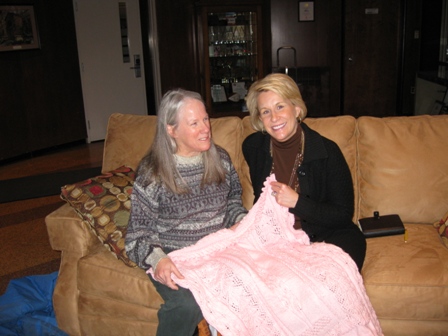
Donna presents a hand-made pink afghan to Scranton-area TV news anchor Lyndall Stout in honor of her work promoting breast self-exam: photo by Rich Hill

In 2008, I presented a pink afghan to former Scranton-area TV news anchor Lyndall Stout in honor of her “Buddy Check” segments, promoting monthly breast self-exam. It features a central panel of entwined vines surrounded by butterflies and candle flames. At the top between two flowers, “Buddy Check” appears in Braille.

Rich and I are still health nuts, but coffee, tea and chocolate are regular parts of our lives. I have remained cancer-free for twenty-three years

The Heart of Applebutter Hill, the novel that healed my broken dreams, is finally out. It has received prepublication recommendations from professionals in education, rehabilitation and the arts as a valuable tool to introduce secondary and college students to the capabilities and issues facing blind Americans.

Butterflies Today

Milkweed and bergamot grow wild here, sometimes right by the house. Hundreds of butterflies of many varieties visit for weeks. A butterfly even ended up in The Heart of Applebutter Hill. The Aki No Choo — Japanese for “autumn butterfly” — is a blue butterfly encased in a crystal ball. A pink heart appears on one wing. It has its own job in the novel, but for the author, it is a reminder of that magical day in Lancaster County, when one particular butterfly brought us hope, foretelling my survival, landing on my arm not just once, but twice.

Free E-Version of The Heart of Applebutter Hill & a Chance to Win YA Fantasy in Print

The Heart of Applebutter Hill book cover shows a cave scene - stalactites reflected in an underground lake, while a hand holds the Heartstone of Arden-Goth: photos, Rich Hill;, design, Lizza Studios.

https://donnawhill.com/book-giveaway-sign-up-read-the-heart-of-applebutter-hill-for-free-and-help-promote-braille-literacy/

What Others are Saying About The Heart of Applebutter Hill

Donna - with her guide dog, Hunter - donates The Heart of Applebutter Hill to Dir. Jesse Johnson of the Towanda Library: photo by Rich Hill

“In a way, the tale acts as an all-encompassing guide to childhood, as it details the struggles of bullying, consumerism and being cast from society.”
1/1/14, Michael Wintermute, Wyoming County Press Examiner
‘Meshoppen author pens mystery novel’ http://wcexaminer.com/?p=39493 

“It was a great adventure story with likable, well-rounded characters with lots of different abilities and struggles — many of which kids rarely get to read about! My favorite was Curly Connor, not many writers write dogs this well! …”
10/22/13 Max Ray, Comments on homepage http://DonnaWHill.com

“Hill believes The Heart of Applebutter Hill will help sighted readers understand the reality of blindness as well as give blind youngsters a character with whom they can identify. Reviewers agree.

‘Hill has done a superb job conveying the impact of going blind, as her heroine finds refuge in music and fantasy,’ playwright Uke Jackson wrote.’

‘I believe Hill has a gem here,’ wrote University of Scranton professor emeritus Patricia Gross. ‘I particularly savored the poetry and songs that underlay the action.” “I believe Hill has a gem here,” wrote University of Scranton professor emeritus Patricia Gross. “I particularly savored the poetry and songs that underlay the action.'”
12/19/13, MARY THERESE BIEBEL, Wilkes-Barre Times-Leader
‘The biggest project of my life’ http://timesleader.com/news/features/1050744/The-biggest-project-of-my-life

“It was one of those books you sit down with and you blink and suddenly discover you’ve read 100 pages…”
2/17/14 Niffer’s Review, Goodreads https://www.goodreads.com/book/show/18153835-the-heart-of-applebutter-hill#other_reviews

“I had the pleasure of getting an early read on Donna’s book; I
still think about the characters, and especially the cloud ship!…”
3/18/13 RobertLeslie Newman Comments on homepage http://DonnaWHill.com

“This book had a mixture of realism and fantasy.
Something for everybody, young and old alike.”
4/24/14, Eileen Corman, Amazon Reviews http://www.amazon.com/The-Heart-Applebutter-Hill-ebook/dp/B00CNG6DDM 

“This book is a great read for young and old alike. Anyone interested in a fiction novel that combines fantasy with reality, humor and adventure, this is
for you. The detail of the imagination of the writer is evident at every turn of the story…”
12/29/13, Lisa E. Robinson, Amazon Reviews http://www.amazon.com/The-Heart-Applebutter-Hill-ebook/dp/B00CNG6DDM

“The amazing thing about the way Donna Hill has written this novel
is that it weaves the experience of a child who is blind into a novel that is engaging on its own. I think it is an excellent choice for parents who want
to provide a unique way to help their children avoid assumptions and stereotypes as they expand their view of diversity.”
3/29/14, B. Wentz, Amazon Reviews http://www.amazon.com/The-Heart-Applebutter-Hill-ebook/dp/B00CNG6DDM

“What I really enjoyed was that the character (who is blind) was portrayed
in a positive, competent way. A great addition to any school or home library.”
January 12, 2014, NW Reader, Amazon Reviews http://www.amazon.com/The-Heart-Applebutter-Hill-ebook/dp/B00CNG6DDM

Meet the Author of The Heart of Applebutter Hill

After workshop on the novel The Heart of Applebutter Hill & Blindness Issues, U. of Scranton Education Students Gather Around Donna & Hunter for a Photo Op: photo by ashley allegraInvite Donna W. Hill to be a guest speaker for workshops, seminars and classes. Topics include writing, songwriting, anti-bullying and mainstreaming students with visual impairments. Write to her using the “Contact” link on this page.
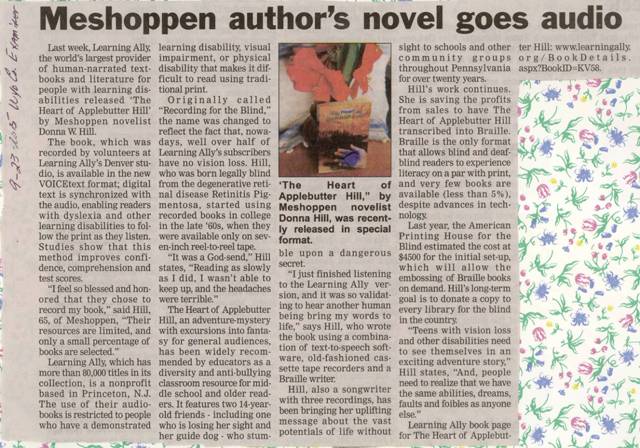
Also coming — contests and special features.

Accessibility Issues for People Using Screen Readers

Screen reader users, there are significant issues with Word Press’s “Leave a Reply” form – which is labeled on this site “So, What Do You Think?”Here’s a “temporary” solution. Every page and post now has a link labeled “Accessible Comment Form for Screen Reader Users.” It will be sent to me, and I will post it on your behalf. The URL is: https://donnawhill.com/accessible-comment-form-for-screen-reader-users-3

Posted in breast cancer, Education, Knitting, Self-Publishing, songwriting, Wrighting | Tagged , , , , , , , , , | 5 Comments

A Writer’s Wormhole: from novelist to publisher in 3 Easy Nervous Breakdowns

Screech Owl in Wood Duck House

Last week, a desperate quest for sanity compelled me to stand down from my mind-numbing routine and ask “What on Earth has happened to me?” I was a writer. Somehow, however, I must have entered one of those wormholes the physicists talk about. While it was a route to another part of the universe where I need to go, it was a journey of suffocating pressure.

The Heart of Applebutter Hill: The Writing Process

For years, I lived in Applebutter Hill, a fictional land with portholes into mythical worlds where two shy teenagers travel in a camouflaged airship dubbed the Cloud Scooper. Classrooms transform into realistic representations of places like Westminster Abbey, and a grumpy acorn inspires a song with the tag line, “Mighty oak trees are nothing but little nuts who stood their ground.” This world is not entirely of my own making. It is inhabited by the spirits of loved ones, friends and even enemies.

My theory of writing is informed by my identity as a journalist. Get the story and write it up; everything beyond the inquiry stage is editing. For fiction, inquiry occurs in the imagination.

Editing a Novel

Once I had it down, I picked and fussed. I combed through the novel for errors, phrases that could be tightened up, things that weren’t clear. I tried to make the dialog more realistic, the narrative crisper. I rearranged paragraphs, sentences and even single words, in a quest to present information in the perfect order for building and sustaining suspense.

I invited others to read my novel and give feedback. Fortunately, I have people in my life who are willing to say something other than, “Yeah, it’s great. I liked it.” I agonized over their comments, took their advice and made changes. Ultimately, the manuscript cowered in fear that I would move a comma, question an adjective or turn something else into a contraction just to reduce the word count.

Bringing a Book from Manuscript to Publication

If I was distracted, forgetful or uninvolved in the everyday details of life while writing and editing, it was nothing compared with the next stage. The novel was done. Though I would love to continue writing, to delve into my notes on a sequel or work on something else entirely, I restrained myself. Nowadays, I am simply shepherding the work of my life through the publication process.

At first, it wasn’t complicated. I researched agents, sent out queries and tried not to despair of the emptiness that was my In Box. But, the clock was ticking and my patience was wearing thin. I decided to self-publish.

What company should I go with? Create Space or Lulu, Smashwords or Book Tango? What about the others? I made my choices (Create Space for print and Kindle; Smashwords for the other eBook options). Did I choose wisely? I have no idea. I suspect that any of the many options would be workable. The wildcard is the author’s willingness and ability to press on with promotions.

Choices, Choices, Choices!

Create Space has several options for every aspect of the process. For the interior design, for instance, you can upload a print-ready PDF or use their online Interior Reviewer, which does the conversion for you – both are free. The trick is that you need to, at the very least, make a properly formatted .doc, .docx or .rtf.

You can also pay them $379 to design the interior for you. I think I truly entered the wormhole, when I realized that Create Space’s discounts on promo copies don’t kick in until you order 5,000. Yeah, that’s “five thousand.” The savings on multiple copies is on shipping only. $379 buys a lot of promotional copies.

The Novel’s Interior Design

I decided to design my novel’s interior myself. Are you raising an eyebrow? Well, get the other one up there; it’s a crazier idea than it seems.

Formatting your book starts with choosing a trim size. 6″ x 9″ is the most popular and the one I chose. Create Space provides guidelines on margins and gutters, and a trip around Word’s Page Set-up dialog turns your manuscript into something resembling a book.

Then there’s Styles. If you’re the average Word user, just throw everything you think you know about formatting out the window; it may look great for printing a manuscript, but that’s not how it’s done. The pros use Styles, not local formatting. A Style is a collection of choices about font and paragraph attributes and parameters (such as what Style the following paragraph should be) bundled together and given a name.

Time for more reading. Being the prudent sort, I practiced on new documents. I congratulated myself on how quickly I was getting the hang of it. Somehow, however, I lost a measure of cynicism and forgot everything I had come to expect from Microsoft. I was, therefore, shocked to learn that Word 2010 doesn’t automatically make these new Styles available to other documents. They need to be imported. Also, unlike Word 2007, the Developer Tab is not on the ribbon.

Book Design: Formatting Problems & Headaches

The problems really started when I tried to import Styles. Since I am blind, I use text-to-speech software to access the computer and the internet. Wonderful as this is, it has some drawbacks. Chief among them is that software and website developers are a baffling combination of uninformed and uninterested, when it comes to adding the 1s and 0s that allow screen readers to communicate with their products.

Running up against some of these stumbling blocks sent me over the edge. I was so close! While hovering over my computer in a state of paralysis, I realized what I should have known all along – I am not, nor do I want to be a professional book designer. My novel deserves better. I conceded defeat. I soothed my ego by assuring myself that I had – in over a hundred hours that I will never get back – at least learned enough about the topic to be somewhat conversant in it. I then threw in the towel, ran up a white flag and spent $397. Was that a mistake? More on that later.

Free E-Version of The Heart of Applebutter Hill & a Chance to Win YA Fantasy in Print

https://donnawhill.com/book-giveaway-sign-up-read-the-heart-of-applebutter-hill-for-free-and-help-promote-braille-literacy/

What Others are Saying About The Heart of Applebutter Hill

The Heart of Applebutter Hill book cover shows a cave scene - stalactites reflected in an underground lake, while a hand holds the Heartstone of Arden-Goth: photos, Rich Hill;, design, Lizza Studios.

“In a way, the tale acts as an all-encompassing guide to childhood, as it details the struggles of bullying, consumerism and being cast from society.”
1/1/14, Michael Wintermute, Wyoming County Press Examiner
‘Meshoppen author pens mystery novel’ http://wcexaminer.com/?p=39493 

“It was a great adventure story with likable, well-rounded characters with lots of different abilities and struggles — many of which kids rarely get to read about! My favorite was Curly Connor, not many writers write dogs this well! …”
10/22/13 Max Ray, Comments on homepage http://DonnaWHill.com

“Hill believes The Heart of Applebutter Hill will help sighted readers understand the reality of blindness as well as give blind youngsters a character with whom they can identify. Reviewers agree.

‘Hill has done a superb job conveying the impact of going blind, as her heroine finds refuge in music and fantasy,’ playwright Uke Jackson wrote.’

‘I believe Hill has a gem here,’ wrote University of Scranton professor emeritus Patricia Gross. ‘I particularly savored the poetry and songs that underlay the action.” “I believe Hill has a gem here,” wrote University of Scranton professor emeritus Patricia Gross. “I particularly savored the poetry and songs that underlay the action.'”
12/19/13, MARY THERESE BIEBEL, Wilkes-Barre Times-Leader
‘The biggest project of my life’ http://timesleader.com/news/features/1050744/The-biggest-project-of-my-life

“It was one of those books you sit down with and you blink and suddenly discover you’ve read 100 pages…”
2/17/14 Niffer’s Review, Goodreads https://www.goodreads.com/book/show/18153835-the-heart-of-applebutter-hill#other_reviews

“I had the pleasure of getting an early read on Donna’s book; I
still think about the characters, and especially the cloud ship!…”
3/18/13 RobertLeslie Newman Comments on homepage http://DonnaWHill.com

“This book had a mixture of realism and fantasy.
Something for everybody, young and old alike.”
4/24/14, Eileen Corman, Amazon Reviews http://www.amazon.com/The-Heart-Applebutter-Hill-ebook/dp/B00CNG6DDM 

“This book is a great read for young and old alike. Anyone interested in a fiction novel that combines fantasy with reality, humor and adventure, this is
for you. The detail of the imagination of the writer is evident at every turn of the story…”
12/29/13, Lisa E. Robinson, Amazon Reviews http://www.amazon.com/The-Heart-Applebutter-Hill-ebook/dp/B00CNG6DDM

“The amazing thing about the way Donna Hill has written this novel
is that it weaves the experience of a child who is blind into a novel that is engaging on its own. I think it is an excellent choice for parents who want
to provide a unique way to help their children avoid assumptions and stereotypes as they expand their view of diversity.”
3/29/14, B. Wentz, Amazon Reviews http://www.amazon.com/The-Heart-Applebutter-Hill-ebook/dp/B00CNG6DDM

“What I really enjoyed was that the character (who is blind) was portrayed
in a positive, competent way. A great addition to any school or home library.”
January 12, 2014, NW Reader, Amazon Reviews http://www.amazon.com/The-Heart-Applebutter-Hill-ebook/dp/B00CNG6DDM

Meet the Author of The Heart of Applebutter Hill

After workshop on the novel The Heart of Applebutter Hill & Blindness Issues, U. of Scranton Education Students Gather Around Donna & Hunter for a Photo Op: photo by ashley allegraInvite Donna W. Hill to be a guest speaker for workshops, seminars and classes. Topics include writing, songwriting, anti-bullying and mainstreaming students with visual impairments. Write to her using the “Contact” link on this page.
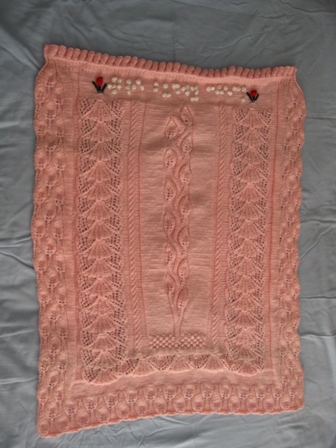
Also coming — contests and special features.

Accessibility Issues for People Using Screen Readers

Screen reader users, there are significant issues with Word Press’s “Leave a Reply” form – which is labeled on this site “So, What Do You Think?”Here’s a “temporary” solution. Every page and post now has a link labeled “Accessible Comment Form for Screen Reader Users.” It will be sent to me, and I will post it on your behalf. The URL is: https://donnawhill.com/accessible-comment-form-for-screen-reader-users-3

Posted in Accessibility, Wrighting | Tagged , , , , , , , , | 2 Comments

Let’s Start with Chocolate!

Laura's Chocolate CakeIt’s almost Valentine’s Day and it seems like a good time to post an article from my “Chocolate Series,” which first ran on Suite 101. Also, chocolate played a very important role in the writing of the book – it kept me going during those long hours of solitude.

Cookmarked founder, Laura Robichaux discusses getting started in the kitchen, baking chocolate cake and her New Orleans roots; she also offers tips for vegans. There’s also a link to a free chocolate cake recipe. Enjoy!

Cookmarked’s Laura Robichaux: Baking Chocolate Cake from Scratch

New Orleans native Laura Robichaux, chocolate cake & vegan specialist and Co Founder Cookmarked comNew Orleans native Laura Robichaux is passionate about baking, health, travel, running, and web design. She spoke to me about the world of options available to those who want to bake chocolate cake from scratch. She also discussed her latest project, Cookmarked.com — an online tool to help people easily share and organize their recipes.
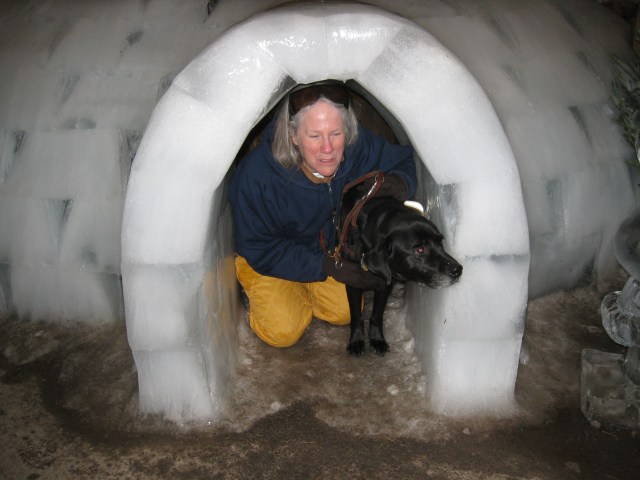
New Orleans Background

Laura’s memories of her New Orleans childhood are brimming with the experiences she had in the kitchen, where her grandmother and father were passionate and devoted cooks. At the center of it all was her grandmother’s cookbook. There was always a big pot of gumbo, jambalaya or shrimp Creole.

“With that kind of cooking,” she explains, “it’s less about exact amounts than about taste-as-you-go.”

Robichaux, who studied Finance and Mass Communications at LouisianaStateUniversity, realized by her sophomore year that she would have to leave her beloved New Orleans to pursue her career goals. She now Works for a big 4 accounting firm in Atlanta, as a Financial and IT Consultant for fortune 500 companies. Her roots and her family, however, remain in New Orleans, and she visits frequently.

When Hurricane Katrina hit, Robichaux was at college, about an hour outside the city. She explains that she’d been hearing about big storms all of her life, and her family was “a bit stubborn about leaving.” Eventually they went to Baton Rouge, where they were without power for several days. Not having cell phone service was the hardest part, since they couldn’t get information. She says that New Orleans has made a lot of progress since then.

“If you were there before Katrina as a tourist,” she states, “you might not notice any difference, until you get to the outer parts of the city. The touristy spots are repaired, but outside about fifteen twenty minutes, you start to see that some neighborhoods haven’t bounced back. Some areas are still abandoned; especially poor areas.”

The Differences in Chocolates

When asked why there is such a difference in the aroma of baking with unsweetened chocolate versus box mixes, Robichaux points to several factors. She explains that chocolate cake box mixes often have lots of artificial flavoring and substitutes for the more expensive chocolates. They taste good and are dependable. However, they lack the complexity of flavors and aromas which come from real, pure chocolate. In addition, there is a wide variety of chocolate available.

“When you purchase chocolate for baking,” she states, “you have many options. There are various qualities of bars and powders from around the world. The finer chocolate beans most likely come from the tropical rainforests of West Africa, the Caribbean, Ecuador, Java, Madagascar and Venezuela.”

Varieties have unique smells and tastes, according to Robichaux. This is due to the differences in the soils and climates in which they grow.

“When you unwrap a product made of these great chocolates,” Robichaux says, “you immediately know — because of the complex aromas wafting up — that this is not a bar of ordinary chocolate.”

Cake Mixes vs. Baking with Real Chocolate

For Robichaux, the choice to use box mixes or to bake from scratch depends mostly on a person’s comfort level. Neither is difficult. If you have never baked before you’ll probably want to do the box first. Baking from scratch allows for more flexibility, such as turning a standard recipe into an espresso chocolate cake or adding nuts.

One of the most important factors, according to Robichaux, is knowing your audience. If you suddenly get a craving for something chocolaty and want it quick, go get the box. If you would like to impress your family or friends at a special occasion, however, make something from scratch.

Chocolate Cake Baking Tips for New Bakers

One of the first choices in baking chocolate cakes is whether to use powdered cocoa or bars of unsweetened or semisweet chocolate. Robichaux explains that Cocoa is more flexible. For starters you don’t have to cook cocoa, whereas the hard chocolates need to be melted. Also, Robichaux sees fewer options for melted chocolate.

When baking from scratch, Robichaux explains that dry and wet ingredients must be mixed separately. When combining them, she adds the dry ingredients into the wet. Consistent temperature is also important. Get the colder ingredients like eggs and milk out of the refrigerator and allow them to come up to room temperature before using them.

There are many types of cookware, but Robichaux doesn’t use anything fancy. She does avoid nonstick cookware, however, because of the health concerns. She just butters the cake pans. Knowing what others think of any given recipe is also important. She suggests choosing a recipe online with good feedback.

“Don’t start playing around with any recipe until you’ve made it according to the directions.”

Baking Substitutions for Vegans

Robichaux states that she has always enjoyed cooking and the science behind it. Now, as a vegan, she is particularly interested in finding different substances to get the same result as the ingredients she no longer uses.

“It’s important to know how an ingredient functions so you know how to replace it,” she states.

Instead of butter, Robichaux prefers Earth Balance, a dairy free, soy free vegetable oil product that cooks like butter. Instead of using eggs, she uses either applesauce or flaxseed.

“The rule of thumb,” she explains, “is to substitute either a quarter cup of applesauce or two tablespoons of flaxseed per egg.”

Milk is another ingredient Robichaux avoids. She also tries not to rely on soy. She has had much success with cocoanut and hemp milk.

“They can both also be turned into buttermilk with a little lemon juice or vinegar,” she explains, “Just set it to the side until the milk separates.”

Cookmarked: A Place to Organize Your Recipes

The Cookmarked concept started because Robichaux, who enjoys experimenting in the kitchen, was having a hard time keeping track of her recipes. She noticed that there are “plenty of blogs to get recipes, but nowhere to keep track of them.”

Along with two friends, she developed Cookmarked, a free online tool which can also be accessed via phone. Cooks and bakers can share their recipes with others and search other people’s recipes. Mainly, though, it’s a place to organize your own recipes.

Visit Cookmarked at:http://www.cookmarked.com/

Check out Laura’s Facebook page:http://www.facebook.com/pages/Cookmarked/126006964123410

Free Chocolate Cake Recipe

If you’re looking to experiment with baking with real chocolates, try using this free cocoa-based Chocolate Cake Recipe:http://cookmarked.com/recipe.aspx?eID=cIUqqOOOR3fAB03govpP3GVZ37z1BgoTqCzEJI2y7T4e

Try substituting various types of chocolate. Experimenting this way will allow you to see what your family and friends prefer. This recipe uses butter and eggs, so vegetarians and vegans should experiment with the substitutions mentioned above. “You won’t get it right all the time,” Robichaux states, “but it feels nice when you do.”

Accessibility Issues for People Using Screen Readers

Screen reader users, there are significant issues with Word Press’s “Leave a Reply” form – which is labeled on this site “So, What Do You Think?” If you are not signed in, you should still be able to post comments, but even if you can access the edit fields and fill them out, the “Submit” button doesn’t work most of the time.

I have advised Word Press Support of this issue. The reply was, “I reported the issues you described, and they may get addressed in a future revision of comments on WordPress.com.”

Meanwhile, here’s a “temporary” solution. Every page and post now has a link labeled “Accessible Comment Form for Screen Reader Users.” It is accessible, but does not link directly to the automated comments system. It will be sent to me, however, and I will find someone to post it on your behalf. Word Press won’t do it, even though I am a paying customer. The URL is: https://donnawhill.com/accessible-comment-form-for-screen-reader-users-3

Posted in Accessibility, Chocolate | Tagged , , , , , , , | Leave a comment

Welcome

Donna and Hunter Look Out from an icy igloo by Rich HillThis space will soon brim with reviews and recommendations, reader feedback, articles on everything from music and chocolate to accessibility and knitting … and who knows what!

If, after you’ve read The Heart of Applebutter Hill by Donna W. Hill, you would like to share your thoughts with the world, you have several options. Just fill out the “So, What Do You Think?” form or (for more elaborate reviews, use the same form to request a guest blog. Comments are not automatically published. They are monitored. We will contact you privately with an e-mail address to send your book review — don’t forget to include a plug for yourself and your URL. Then, we will post your review to this blog.

Accessibility Issues for People Using Screen Readers

Screen reader users, there are significant issues with Word Press’s “Leave a Reply” form – which is labeled on this site “So, What Do You Think?” If you are not signed in, you should still be able to post comments, but even if you can access the edit fields and fill them out, the “Submit” button doesn’t work most of the time.

I have advised Word Press Support of this issue. The reply was, “I reported the issues you described, and they may get addressed in a future revision of comments on WordPress.com.”

Meanwhile, here’s a “temporary” solution. Every page and post now has a link labeled “Accessible Comment Form for Screen Reader Users.” It is accessible, but does not link directly to the automated comments system. It will be sent to me, however, and I will find someone to post it on your behalf. Word Press won’t do it, even though I am a paying customer. The URL is: https://donnawhill.com/accessible-comment-form-for-screen-reader-users-3

Posted in Accessibility, Education, Wrighting | Tagged , , , , , , , , | Leave a comment