Novel or Scrapbook: the Benefits of Being a Writer

A Goodreads member recently asked my thoughts on the best thing about being a writer. The following is based on my answer.
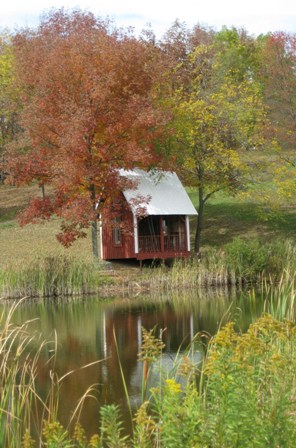
Hills' gingerbread pond shelter flanked by trees in autumn colors: photo by Rich Hill

My first inclination was to make it clear up front that in enumerating the wondrous world of the writer, I am in no way advocating it. If you aren’t driven to write, you’ll find little comfort in the joys of being a writer. If you are, you don’t need a sales pitch. So, there, I’ve said it. What does it say about me that I felt the need to start with a disclaimer?

The Joys of Writing: Crossing the Great Divide
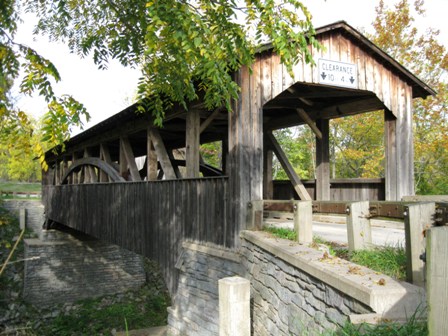
covered bridge at luthers mill west of towanda, PA in fall: photo  by rich hill

Writing, like all endeavors purposefully pursued, brims with both benefits and burdens. The burdens of being a writer — such as the pain of finishing a beloved story, the agonies of writer’s block and the sucker punch of criticism that comes out of left field — will have to wait for another time.

Writing has brought me countless hours of joy, as I abandon myself to the creation of stories and articles, pushing the boundaries of my understanding of life and language in the search for words and structures that will enable something to pass between the abyss of one human being’s reality and another’s — something we call communication. Certainly one of the best things about the craft is the sense of satisfaction and the power of creating something that means something. If someone else appreciates it, so much the better.

Juxtaposing Two Worlds … Twice

Fiction insists that we create a reality, but does not bind us to what purpose that reality will serve, how closely it mirrors the “real” world or in what ways it comforts, disturbs, challenges or affirms us, both as writers and readers. In my novel, The Heart of Applebutter Hill, my primary intent was to explore the possibility of engaging the reader in a fast-paced adventure that bridged reality and fantasy, while shedding light — through osmosis — about the realities of life in the gray area between the blind and sighted worlds.

I made up the setting — creating a fictional land, characters and possibilities that blend science fiction and fantasy, using bits and pieces of the settings of my life. In many ways, the novel is a scrapbook for me, as it incorporates locations, buildings, animals, people and incidents from every stage of my life.

Imagination & Reality: Weaving a Novel’s Setting

The upper school at the Plumkettle Learning Center — the “blocky, two-story, red-brick, relic of the 1920s” — is based on Pennsylvania’s old Easton Junior High School. The cafeteria, auditorium, library and stadium are in the same locations as they were back in the ’60s, though in reality Butler Street was behind the building, not in front of it. The Upper Nickel, the high-tech room in which students experience 3-D excursions to Westminster Abbey and the Parthenon, complete with olfactory and tactile sensations, jumps the line between “almost possible” and science fiction. The powerful Heartstone of Arden-Goth, Rutherford and the Cloud Scooper are totally in the realm of fantasy.

Applebutter Hill is the road in Coopersburg, Pennsylvania where my mother’s family is buried. When I first heard the name, it had an immediate and transformative impact upon me. The fictional Applebutter Hill incorporates bits of Easton, the Germantown section of Philadelphia and Glenside in Montgomery County, where I lived prior to moving with Rich to the Endless Mountains.
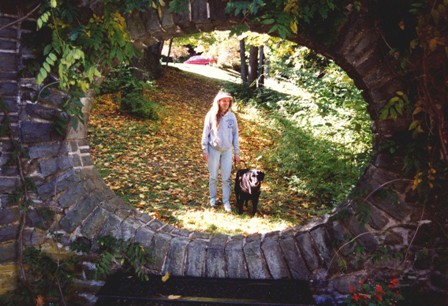
This picture of a blind girl & her black guide dog in the oval opening in a stone wall at Grey Towers National Historic Site could be Abigail & Curly Connor from The Heart of Applebutter Hill at Bar Gundoom Castle: photo by Rich Hill

Morganheim and Elfin Pond Road, the country setting of the book where Baggy, Captain Sodpeg and the Blusterbuff’s live, is based on our current surroundings. The Castle of Bargundoom is a massive exaggeration of the Grey Towers National Historic Site in Milford, Pennsylvania, the ancestral home of Gifford Pinchot, (1865-1946), first Chief of the US Forest Service and twice Governor of Pennsylvania.

Fiction: a Vehicle for Memorializing Lost Loved Ones
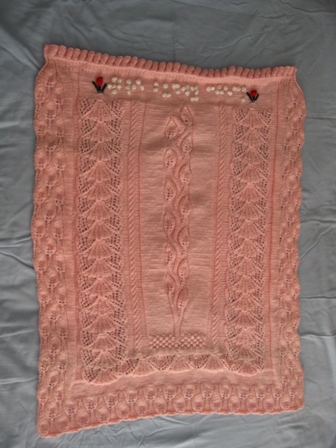
Pink breast-cancer-awareness afghan for WYOU anchor Lyndall Stout's Buddy Check segment; designed and knit by The Heart of Applebutter Hill author Donna W. Hill,  features twining vine surrounded by butterflies and candle flames: photo by Rich Hill

Dealing with loss is a problem that plagues us all. Being a novelist gave me the opportunity to create places for people from my life who are no longer walking in this land of reflected light, people I miss deeply, and whose spirits seem to walk more closely with me because of the new roles they are playing in my fiction.

Several are women who fought the good fight against breast cancer. I don’t use their real names — at least not entirely. Both of my grandmothers — known as Mrs. Shafer and Mrs. Ervy — are employed by the Plumkettle Learning Center as house mothers for Transition House, where all new refugee kids live until they find guardians.

Butterfly on Bergamott in Pennsylvania's Endless Mountains: photo by Rich Hill

Yuki, the castle’s art director, is based on my sister’s mother-in-law who, as a Hiroshima survivor, had much more to deal with than her breast cancer. My friend Dagmar appears as Dagmar Kiffle, the adaptive education resource instructor who teaches Abigail to use a computer with text-to-speech technology, Braille and a lot more. The real Dagmar was a low-vision therapist, so it’s not much of a leap to see her in this role.

Writing in a Bit of Revenge

On the other hand, there are people, especially from my childhood, who made my life miserable by either allowing or participating in bullying. There appeared to be no end to the enjoyment they received from tormenting a blind kid. They make perfect villains, and I enjoy trashing their reputations in print in ways that I never could have in real life. The beauty is that, if they ever read this, they will know it’s them, but saying so will just expose their guilt — not that that would be such a bad thing.

Though most of the plot is entirely fictitious, I incorporated at least a half dozen little incidents that happened to me in real life. Abigail’s experience at the World Boutique and the incident in the street when she was yelled at by a passing stranger both happened to me, though fortunately not in the same day. The prejudice she encounters when she tries to join the school’s newspaper staff was also part of my school experience, though I didn’t have as much help in confronting it or dealing with its impact.

The Best Thing About Writing

But, the questioner asked for “the best thing.” If I have to whittle it down to one overriding benefit, I must say that it is simply the possession of an outlet, an activity that allows me to make sense of the misery, explore the joy and simply view everything from a place that is both safe and challenging, a place where I can grow and, in doing so, create something to share.
Posted in authors, Blindness, breast cancer, bullying, fantasy, novel, Uncategorized, Wrighting | Tagged , , , , , , , | 3 Comments

Friendships in the Dark by Phyllis Campbell – a Book Review

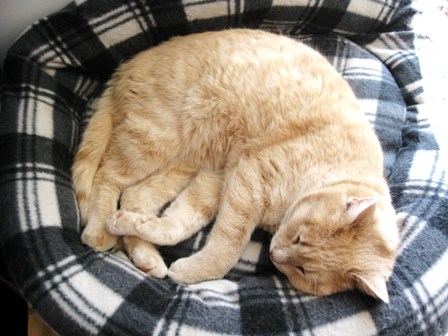
Goofus, a rescued strawberry-blonde tabby, is curled up in his bed: photo by Rich Hill

Friendships in the Dark, Vol. 1Friendships in the Dark, Vol. 1 by Phyllis Campbell
My rating: 5 of 5 stars

When you read the subtitle of Friendships in the Dark, what do you think you’ll be getting? Stories about great people? Great animals? If so, you would be correct; this book has awesome dogs, cats and people in spades. It’s an excellent read on so many levels — not the least of which is that it gives us a glimpse into the world of America’s “Greatest Generation” from the perspective of someone who witnessed its realities as a child.

Each chapter begins with a quote — always a crowd-pleaser for me. My favorites are: 1. “No one ever gets far, unless he accomplishes the impossible at least once a day” – Elbert Hubbard 2. “Hope against hope, and ask till you receive.” James Montgomery and 3. “Our greatest glory is not in never falling, but in rising every time we fall.” Confucius.

If you stumbled over the part about a “blind woman,” however, you may be wary, worried that you just don’t want to read something that makes you feel sorry for someone’s problems or that, whatever compensations that may have come into this woman’s life, you would find small comfort in them. If that’s the case, my sympathies, because you are woefully off base.

“I have never felt cheated of the rich beauty the world has to give,” writes Campbell, who was born totally blind, “For as long as I can remember, I have reached out to the world around me, giving and taking all the good things life has to offer.”

Friendships in the Dark is the story of exultant joy in the midst of life’s challenges, the power of dedicated teachers, humor and a casual honesty brought to life for the reader by a master writer. Campbell’s prose is playful, happy without being sappy, poignant without being morose, a perfectly balanced view into the best of family, community and the triumphant splendor of the human spirit.

Phyllis Campbell was a child living on a Virginia farm during WWII, the youngest of four children. It’s a home filled with love, concern for A brother going off to war and the determination of a mother that her girls were going to be successful and independent, despite what the neighbors think.

Yes, Phyllis wasn’t the first blind kid in the family. Seven years her senior, Inez was also blind, and she teaches Phyllis Braille and awakens in her a love of reading that would guide her throughout her life.

When it’s time for Phyllis to join her sister at Virginia’s residential school for the blind, their older sister Fay gets a job there to be with them. Six-year-old Phyllis falls ill and experiences the problems that faced children needing procedures at a time when the doctors were overseas. Soon, her father leaves the farm he loves and takes a job in town so the family can be closer. The cows and horses can’t come, but can her parents bring young Phyllis’s beloved dog and cat?

Campbell shows us dogs and cats like no one else can — how they interact differently with blind and deaf children, how they befriend mentally ill patients at the hospital where her father works and how they purr and wag their ways into even the most reluctant hearts.

This is the story of a young girl growing into a mature, loving, talented and independent woman, the story of how music, flowers and a dog bring that woman and the love of her life together and the story of countless improbable but true ways that dogs and cats play vital roles in the lives of their people. It is also the story of how a guide dog named Leer gives a woman independence even as she loses sight of its true meaning.

There is sadness, but Phyllis is optimistic and confident from the beginning, largely protected from the humiliation, despair and isolation many blind people experience. Her story is a reminder to those who have experienced it and an awakening to those who haven’t of the incredible joy which is possible when we reach out to one another as equals, embrace family and community, and are reassured that, whether or not our prayers are answered, they are always heard.

View all my reviews

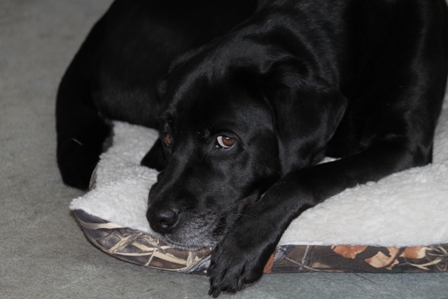
Hunter, a black Lab guide dog, is looking out from his bed under the table: photo by Rich Hill

Posted in authors, Blindness, Book Reviews, Cats & Dogs, Dogs, Guide dogs, memoir, Service Dogs, Uncategorized, Visually Impaired, Wrighting | Tagged , , , , , , , , , , | 6 Comments

Advice for aspiring writers: Get Your Editor On

Recently, a member of the Goodreads community asked for my advice to aspiring writers. My answer could have gone in so many directions — getting published, building your personal brand, incorporating time into your life to write — the list is endless. The following is based on my original answer.

One Writer’s Self Image

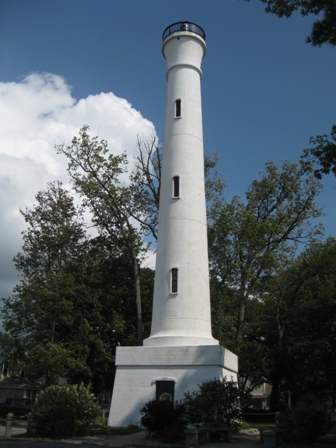
Verona Beach Light, one of 3 working lighthouses on NY's Oneida Lake: photo by Rich Hill

I’m a bare-bones, cut-to-the-chase sort of person in general, so my first thought is to suggest that you step back from the trappings of whatever your image of the writer is. Parading around in public with your notepad at the ready, skulking in the shadows of community with a drink and brooding may work for some writers, but make sure it’s working for you before you commit your entire identity to it.

After all, it’s what comes out on the paper that matters, and that depends on what goes on in your head and your ability to do the thinking, research and editing necessary to come up with a polished product. Before writing my novel, I wrote everything from music and publicity material to news articles, memoir and in-depth profiles. Most of it was nonfiction, and that has influenced my perspective on writing.

Fiction or Nonfiction: the Writing Process is Identical

In some fundamental sense, all writing is the same. Get the story, write it down and start editing. Reporters have to find the truth in the real world. Novelists find the truth in their imagination. Whatever the story is, go over and over it in your mind, searching for discrepancies, asking the difficult questions and viewing it from many perspectives.

Novelists, like journalists, are often well-served to do real-world research to add to the authenticity of their books. In The Heart of Applebutter Hill, our heroes are the only witnesses to a tractor accident. Despite having grown up as the daughter of a volunteer first responder, I read up on first aid before penning that scene. Similarly, exploring the occasional cave didn’t provide me with enough first-hand knowledge to authentically portray Abigail and Baggy’s planned excursion into the cave at Missing Creek.

Writing That First Draft

Butterfly on Bergamott in Pennsylvania's Endless Mountains: photo by Rich Hill

Your first draft should be a joyous regurgitation of the story within — free-flowing ideas, unfettered by concerns about anything. You won’t have included everything; allow yourself the freedom of assuming that other important ideas will come to you as you proceed — refinement of the details, ferreting out mistakes and inconsistencies as well as changing perspectives on how to tie things together. Once you’ve gone as far as you can, remind yourself that the reason they call it the “first” draft is that there are normally many more to follow.

Now, take a deep breath and get to work. Start the rewriting process by looking at how you have parsed out the details. Facts are a double-edged sword. If you tell the reader too much detail up front, you have limited how you can use that detail to create and sustain suspense.

Furthermore, some descriptions, which may seem insignificant to you at first, could place limitations on where the story is going. If you say that there’s no back door, for instance, there won’t be one if you need it. The only thing standing in the way of your changing things at this point is your attachment to the magic of your own words. Save those “not quite right” gems in another file for another day.

Find the Editor Within

Lock 24 on the Erie Canal in Baldwinsville, NY, mid September: photo by Rich Hill

A writer who is not his or her primary editor is a writer who entrusts the most important aspects of the work to someone else. Without significant editing, all writing is a collection of ideas, a shadow of its true potential. So, learn to love being an editor.

Consider word count, even if you don’t feel that you need to. Focusing on word count enables you to make your writing crisp, avoid repeating yourself and engenders in you an appreciation for your readers, who are there to be entertained or informed, not to get migraines from disjointed and cumbersome prose. Respect the conventions of spelling, word usage and grammar. Look at each sentence to see if it would be stronger if the information were presented in a different order or using different words.

The best editing is done with a scalpel not a hatchet. It takes much longer to figure out how to weave in a subplot than it does to hit the delete key. Sections that strike you as off-the-beaten track may simply be great ideas that you wrote out all in one place instead of weaving into the story.

Pre-publication Readers: Bracing Yourself for the Echoes Across the Canyon

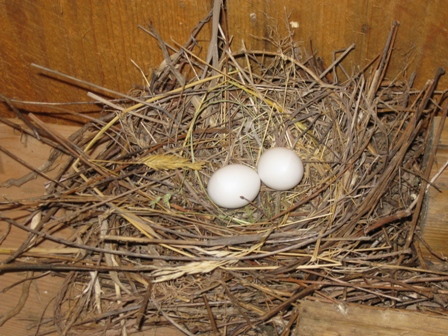
Dove eggs in nest inside shelter near pond in Pennsylvania's Endless Mountains: photo by Rich Hill

Eventually, you will need others to read your work. Prior to publication, the worst reaction you can hear is, “Yeah, I liked it. It was great.” Don’t confuse encouragement with honesty. Find people who are willing to tell you the hard truth about the ways in which it falls short and listen to their intent.

If they’re not writers, they may not explain their reaction in terms that truly define the problem. “You lost me” at this or that point might mean that your writing was unclear or that you didn’t think through the scenario carefully enough or that you were too wordy. Take their comments to heart and see if you can determine what it is about your work that could have caused that reaction. Like the customers they are, readers are always right.

Posted in authors, novel, Uncategorized, Wrighting, Writing Process | Tagged , , , , , , , , , | 5 Comments

Same-Sex Marriage, Americans with Disabilities & the Unintended Consequences of Refusing to Do Business

Since same-sex marriage became legal in Pennsylvania, most wedding-industry businesses have been welcoming to their new customers. Nevertheless, here in Northeast Pennsylvania, several stories of discrimination have fowled our local news. W.W. Bridal Boutique in Bloomsburg, Cake Pros Bakery in Schuylkill Haven and the Inne of the Abingtons in North Abington Township, Lackawanna County have all refused to serve gay couples in the name of Jesus. Currently, no Pennsylvania law prohibits this discrimination. The ACLU is fighting to change this, but why is it a legal issue to begin with?

The Right to Refuse to Do Business

Businesses have always had the right to refuse to serve certain customers. A bartender can deny yet another drink to a clearly intoxicated patron. Restaurants can enforce neutral dress codes – as long as they are applied equally to all; if the sign says you need a shirt with a collar, shoes or a jacket and tie, and you aren’t dressed appropriately, you can be turned away. Gun shops can deny customers when they feel uncomfortable selling lethal weapons to them. Anyone who is behaving in a way that is threatening to others or that causes damage to any business can be asked or forced to leave.

All of these situations, however, involve behavior that either directly impacts the operation of the business or which the proprietor fears could lead to unlawful activity after the customer leaves (– e.g. driving while intoxicated or shooting someone.

Same-sex couples trying to purchase a wedding gown, cake or to rent a facility for a reception do not meet these standards. They are being denied service for who they are and not what they are doing. Marrying someone of the same sex in Pennsylvania is not against the law, and there is no evidence suggesting that anyone believed the actions of these same-sex couples was anything but appropriate.

Religion-based Discrimination Against People with Disabilities

As a blind person using a service dog, I am aware of more and more instances lately involving Muslim cab drivers, restaurant owners and motel franchise owner-operators who are refusing accommodation to people with disabilities using service dogs. Muslims traditionally believe that dogs are unclean, and their religious conviction, the right to which I assume the religious-freedom crowd values Constitutionally as much as they value the rights of Christian wedding-industry business owners, are being used to justify violating the Americans with Disabilities Act (ADA).

The results of this exercise of religious freedom is further marginalizing a population which is already experiencing a 70% unemployment rate. Otherwise able-bodied blind adults of working age have the unhappy distinction of being the minority group with the greatest disparity between education, talent and skill on the one hand and actual employment on the other.

“Sorry, Boss, I’d have been here on time, but ten cabbies passed me by because of my guide dog,” may be true, but it also may be the reason you get fired or that you didn’t get the job to begin with.

ADA Violations – not What You Might Think

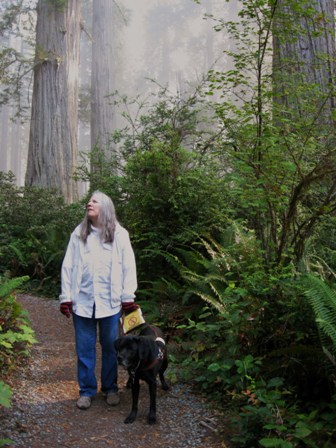
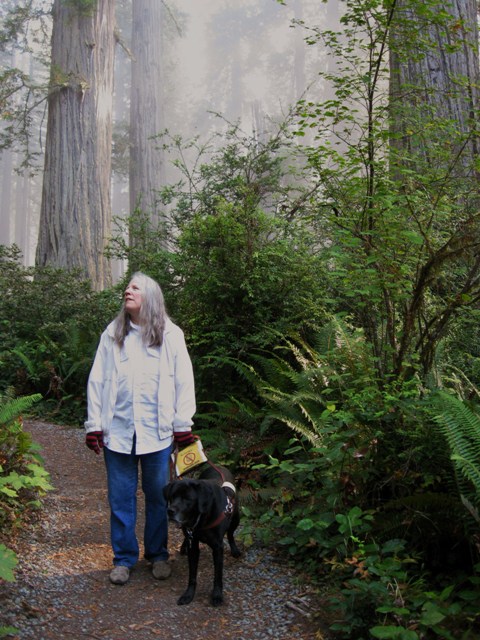
Donna W. Hill, author of YA fantasy The Heart of Applebutter Hill, & her guide dog Hunter on path in Redwoods with a glowing mist: Photo by Rich Hill

Oh, but Americans with disabilities have remedies under the ADA. I filed a complaint with DOJ in June of 2013, when we were thrown out of a motel room that we had already paid for and occupied, because I use a guide dog. I was told that it could take 90 days till I heard anything. Nine months later, I had to write to my US Senator.

We are still in the Mediation process, in which (if there’s a settlement) no one admits to guilt. The actual people who threw us out are, we are told (no one has the authority to verify this) no longer working for the company. Training of the motel personnel (again we must take the respondent’s word on this) consists of reading a section of a manual about service dogs – a section which the employees in question didn’t think applied to them, because their religious conviction was that dogs should be excluded from a “no pets” facility.

Individual Rights vs. the Public Good

Freedom must be tempered to some extent for the public good. The old saw about not yelling “Fire!” in a crowded theater is the gold standard for the appropriateness of limiting freedom of speech. If the sweet lady at the bakery gets on TV because she refuses to bake a cake for a same-sex couple who are renewing their wedding vows (within the law in Pennsylvania), one predictable result akin to the injuries during the stampede in the theater, is that there is a sense of legitimacy for acts of intolerance ranging from playground bullying to the assault of openly gay adults.

Discrimination plants the seeds of intolerance, and the atmosphere of intolerance spreads beyond the gay community to other minorities. Some people, including Christians, believe that a child with a disability is a punishment from God. Such beliefs foster all sorts of discrimination. People with disabilities are not immune to bullying, harassment and assault, a fact which apparently surprises some Americans to the point of disbelief – more evidence of the extent of the marginalization.

Taking a Stand & How the Courts See It

In my naive concept of what American freedom means, it seems to me that when you decide to open your business to the public, you are expected to be welcoming to the whole public as we are in that moment of time. If you can’t in good conscience serve customers who are abiding by the law, then perhaps it is time to take a real stand and close your business entirely.

No one is forced to go into business, and dealing with the public is often cited as one reason many don’t. For the sake of the common good, those who do should accept the public as we are. Refusing to do business with someone should be restricted to situations where a person’s immediate behavior is out-of-line with what is normally expected. Baking a cake for a same-sex couple’s legal wedding may be distasteful to a Christian baker, but their religious freedom still allows them to hold their hateful beliefs and to do what they can to change the law.

Fortunately, the courts usually place a higher value on preserving equality than in giving one person the right to express their prejudices. LegalZoom provides information and services for new businesses. In their September, 2007 article The Right to Refuse Service: Can a Business Refuse Service to Someone Because of Appearance, Odor or Attitude? Leanne Phillips concludes:

Block quote
Like many issues involving constitutional law, the law against discrimination in public accommodations is in a constant state of change. Some argue that anti-discrimination laws in matters of public accommodations create a conflict between the ideal of equality and individual rights. Does the guaranteed right to public access mean the business owner’s private right to exclude is violated? For the most part, courts have decided that the constitutional interest in providing equal access to public accommodations outweighs the individual liberties involved.
Block quote end

https://www.legalzoom.com/articles/the-right-to-refuse-service-can-a-business-refuse-service-to-someone-because-of-appearance

Discrimination: the Slippery Slope

Fawn in grass east of house: photo by Rich Hill

If we allow some Christian bakers, who attribute to Jesus the words and prejudices of St. Paul and the Old Testament while ignoring His admonishment to “Judge not and be not judged,” to use their interpretation of their religion to justify acts of discrimination and unkindness, what about others who feel that tattoos and body-piercings are acts of desecration of the body and contrary to their beliefs? What if a business owner doesn’t believe that God wants him to serve a convicted criminal, someone he thinks is a drug user or someone he just doesn’t like? What off-the-wall opinion would be out of bounds? Exercising religious beliefs in a way which casts an air of exclusion over the public landscape isn’t good for business, community, democracy or faith.

I can’t help but marveling at the rationale behind the whole “In the end I have to answer to God” thing. It’s like they’re expecting that, after they die, they will hear, “Hey, I’m really disappointed in you. You were kind, nonjudgmental and made an effort to treat all of my children with dignity and respect. We just can’t have that sort of thing.”

Posted in ADA, Blindness, Disability, Guide dogs, Refusing to do business, Same-sex marriage, Service Dogs, Uncategorized, Visually Impaired | Tagged , , , , , , , , , , , , , | 2 Comments

Book Review – Being Legally Blind by Justin Oldham

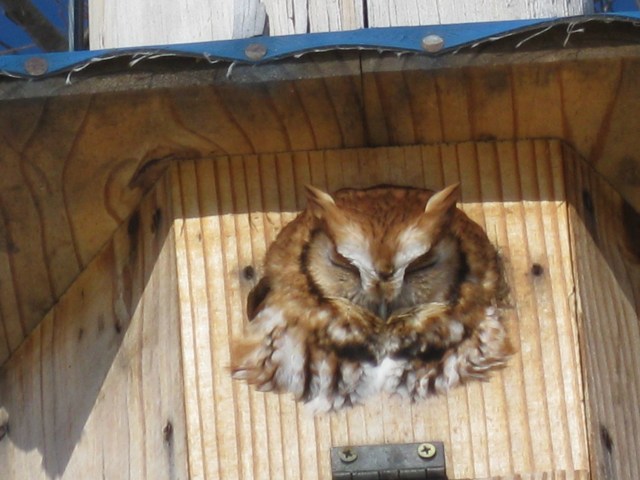
Screech owl in Hill's wood duck house: photo by Rich Hill

Being Legally Blind: Observations for Parents of Visually Impaired ChildrenBeing Legally Blind: Observations for Parents of Visually Impaired Children by Justin Oldham
My rating: 5 of 5 stars

Sooner or later, all parents, despite the joys of bringing a new life into being and the hopes for a wonderful bond with their offspring, run up against the harsh reality that they are totally unprepared for the job. Imagine on top of all of that what it would be like to have a child who was visually impaired — not totally blind, but nowhere close to being fully sighted. What would you expect of that child? How would you deal with your own prejudices about blindness? Did you even realize you had prejudices?

, Prior to writing Being Legally Blind, Justin Oldham published a spy novel and
a science fiction short story collection. He was born legally blind. He has the greatest empathy for parents struggling with These issues. This is the book he wished his parents would have had and the one his mother told him he would write one day — a manual addressing the many thorny issues of successfully parenting a legally blind child.

This includes the fears and prejudices of parents, who often have no experience with the capabilities of blind people and the small-minded professionals whose idea of helping is to counsel parents to expect less from their legally blind child than they would if he or she were fully sighted. These two issues, in my opinion, are the cornerstones which support one of the greatest paradoxes and injustices of humanity. More than two-thirds of working-age legally blind Americans are unemployed or under-employed, and yet some blind people are working successfully as chemists, mechanics, lawyers, beekeepers, teachers and in any profession you can name, except driving. Several blind people have graduated from medical school, while others are NASA engineers and assistant district attorneys in major cities. The successful ones aren’t savants or geniuses and they haven’t been allowed to skate by out of pity. Someone in their lives expected them to succeed and helped them acquire the skills and technology they’d need to accomplish their goals.

Any parent can “inadvertently impress on their kids that what they are is more important than who they are,” according to Oldham. He explains the root of his parents’ initial prejudice about his role and potential as a blind person.

Block quote
My parents were both born and raised in strict, deeply devoted, religious families. My mother was perky, popular, and fashionable. My father was a handsome track star on his way to a meteoric military career. Both were frugal, with few vices. A tenet of their faith at the time I was born was that birth defects were a punishment from God. The news that I had a significant visual disability—that I was “broken”—hit them hard.
Block quote end

Like the individuals they are, parents come to terms with these issues in their own ways and in their own time.
Block quote
My mother was afraid that she’d break me. My father wasn’t sure I could survive the rigors of being the accident-prone child that I was.

Poor eyesight, in and of itself, doesn’t diminish curiosity. Without ever knowing it, my father sowed a huge field of doubt that plagued me for many years. By the time I was five, I had just enough words in my vocabulary to understand that he thought that the prognosis for my future wasn’t good. In his mind, being legally blind meant bad things. When he talked about me in the presence of other people, his words and tone communicated that negativity.

My mother’s message contrasted sharply with what I heard my father say. In her mind, there was no doubt about what I would eventually become. Her warnings scared me when she talked about the troubles I would face, but her optimism filtered through even when she talked about me to other people.
Block quote end

Another major issue tackled in the book is the “definition” of legal blindness, which sounds simple on the surface. A totally blind child cannot see anything, and a legally blind child does see something. Most people with severe visual impairments are not totally blind, and that in itself leads to confusion. Legally blind children are confused about why they can see this and not that, why they can see something sometimes and not others.

What each legally blind child sees is unique to that child. Many people who grew up legally blind had the experience of being told by the adults in their lives that they were “faking” their disability. Oldham gives parents the tools they need to come to an understanding about what their child can and cannot see and what external conditions can alter this equation. He also talks about the variety of low-vision aids available, and how he has incorporated technology into his life to maximize his vision and independence.

One of Being Legally Blind‘s greatest values is the candor with which Oldham discusses the bullying he experienced from his peers, and his advice on how both parent and child can learn to deal with being different. The idea that anyone would bully a child with a disability is startling to many people, often to the point of disbelief. Nevertheless, it happens, and nowadays, some blind people are beginning to speak out about it.

Oldham knows from personal experience that it is not sufficient to know that there are bullies. His clear and poignant insights on the personalities of bullies and verbal vs. physical cowards provide useful insights for all parents, whether or not their child has a disability. But, Oldham goes beyond bullying to a much broader issue.

Block quote
The small number of bullies out there will always remain a dark force with which to be reckoned. However, the numbers of “normal” kids who pick on those with disabilities are a much larger menace to your child’s physical and emotional security.
Block quote end

View all my reviews

Posted in Accessibility, authors, Blindness, Book Reviews, bullying, Disability, Education, Uncategorized, Visually Impaired | Tagged , , , , , , , , , | Leave a comment

Book Review: Sizzling Sixteen by Janet Evanovich

The Heart of Applebutter Hill author Donna Hill & Hunter walk along a path in California Redwoods: photo by Rich Hill

Sizzling Sixteen (Stephanie Plum, #16)Sizzling Sixteen by Janet Evanovich
My rating: 5 of 5 stars

I had no intention of reviewing all of the Stephanie Plum books. I don’t have time to review most of the non-Plum books I read or read all of the non-Plum books I’d like to read. Suffice it to say that all the Plum books are 5s — even the one’s I haven’t read yet. Some, however, qualify as more of a 5 than others, and this one’s a super-5.

This is the Plum novel with the hobbits. It’s the one with the ever-delightful Mooner returning to the spotlight. It’s the one where we get to see Vinnie out of his office and wearing Stephanie’s underwear. It’s the one where Stephanie explains why Trenton’s senior citizens are like the mob and the difference between how men and women behave when they’ve achieved something great. There’s plenty of food, plenty of Lula, plenty of fire and some real sweetness between Stephanie and the two men in her life.

It’s also the first Stephanie Plum novel my husband read. He doesn’t share my need to read things in order.

“It doesn’t matter what order you read them in.”

It matters, but that’s a battle for another day. At least he’s reading and enjoying them. After 16, he read 1-3 in order, skipped to 15, 17 and now he’s reading 12.

You readers who don’t have print disabilities and can’t listen to Annie Wauters read Stephanie Plum for the National Library Service for the Blind & Physically Handicapped are really missing something spectacular. I can’t wait to re-read 12, and I won’t wait to start any later than this evening. The other books I’ve started will just have to wait till I’m feeling less like I’ll crack up from stress if I don’t let myself crack up from Plum.

What I really, really want is a “Rangeman” pouch for my guide dog’s harness handle; he is, after all, in the security and protection industry, and he’s already dressed in black. The heck with the “Ignore working dog” sign; no one notices it anyway.

View all my reviews

Posted in authors, Book Reviews, novel, Stephanie Plum, Uncategorized, Wrighting | Tagged , , , , , , | 3 Comments

ADA: 24 years — Why People with Disabilities are Complaining

Americans with disabilities are supposed to have equal rights. They are protected by federal law from discrimination in areas such as employment, public accommodations, transportation and government services. The landmark legislation establishing these rights and the framework to procure and ensure them, the Americans with Disabilities Act (ADA), celebrated its 24th anniversary on Saturday. As a writer and a person with a disability, I was curious how or if this occasion would be marked.

so on Monday, I Googled “ADA 24th anniversary.” The first thing that was an actual news media story was John Michaelson’s Saturday article for Iowa’s KMAland “Iowa Recognizes Advancements with 24th Anniversary of ADA.” It was the 6th item in the Google Results. A couple other articles from Iowa and one from St. Louis followed before the .orgs started showing up again.

ADA: the Most Important Thing You Need to Know

Becky Harker, executive director of the Iowa Developmental Disabilities Council, summed it up in Michaelson’s article, “… one of the issues is that the ADA is complaint-driven. So, until somebody complains, there’s really no enforcement. And I don’t think that people with disabilities understand that, always.”

Harker needn’t have been so specific. I don’t think the public at large gets that either. If someone ploughs into your car on the highway, the police show up and investigate the incident. The government, not the victim, takes charge of the crime and the administration of justice. It may just be a fender-bender, and you may not be hurt beyond a shake-up, but if the police find the cause of the accident to be a drunk driver, they don’t ask you if you want to press charges. The person involved you in an accident, but they were a menace to anyone on the road.

For people with disabilities, however, incidents of discrimination that may have far-reaching implications for their lives do not so easily fall into the government’s lap. And, no, there’s no one to call to get the process started and no one to take down your account of what happened. People with disabilities must fight for these rights pretty much all by themselves.

Dealing with ADA Violations

If a person with a service dog, for instance, is barred from entering or asked to leave a restaurant or motel, and if that person is unable to convince the employee of the truth of the law, the person often has to simply leave. Even local police cannot force the business to honor the ADA. The justice process doesn’t start until the victim files a complaint with the Department of Justice. At that point the wheels of justice are set in motion.

And, that happens in a timely manner, right? Because, the DOJ has this great system, a partnership with the business community whereby disputes are resolved quickly and fairly through mediation. Well, maybe not quite.

Access Denied: Guide Dog User Tossed from Motel Room

Donna & her guide dog Hunter walk along path in Redwoods. There's a glowing mist: Photo by Rich Hill

I had an incident a year ago. My husband, my guide dog and I were thrown out of a motel room we had already occupied. The reason given by the motel employee and his building manager was that they believed it was OK under the law to restrict service dogs to rooms set aside for pets, and we were in a room in the “no pets” section. Do you think it should be OK to put the guide dogs in with the pets? Well, if you do, you can talk to your elected representatives and try to get it changed.

Meanwhile, that’s not how “equal access” is being interpreted by the courts. Such restriction subjects people with disabilities to the ill-mannered, unkempt beasts that all too often pass for pets. It’s dangerous, but more importantly – at least to the law – is that it does not represent equal access. Worrying about whether a future occupant of the room may be allergic to the service dog isn’t a valid reason for segregating service dogs either.

OK, so we file a complaint. Then, what? First you get an acknowledgment that DOJ received your complaint and advising you that it may take 90 days till you hear back from them, because of the high volume of complaints. So, you wait. I waited nine months. Then, I wrote, called and cc’d my US Senator. Shortly thereafter, we received a letter asking us to agree to mediation. We did, and the motel owner did as well. Then, mediation started with one snafu after another.

It’s been over 14 months since the incident, and nothing is resolved. As time permits, I hope to do a post or two on some of the many problems with the mediation process, but suffice it to say for the moment that “justice delayed is justice denied.”

Posted in Accessibility, ADA, Blindness, Disability, Guide dogs, Service Dogs, Uncategorized, Visually Impaired | Tagged , , , , , , , , | 1 Comment

Book Review: The Big New Yorker Book of Dogs

Donna & her guide dog Hunter walk along path in Redwoods. There's a glowing mist: Photo by Rich Hill

The Big New Yorker Book of DogsThe Big New Yorker Book of Dogs by The New Yorker
My rating: 5 of 5 stars

Ever since humans started throwing scraps to the adventurous wolves beyond the firelight, dogs have been inspiring us and drawing forth from us the full spectrum of our emotional capacity. From enjoyment, love and gratitude to exasperation, fear and cruelty, our reactions to our furry companions have been a mirror of our greatest virtues and our deepest shortcomings. If you’re thinking of reading The Big New Yorker Book of Dogs in the hopes of finding one warm and fuzzy, tug-at-the-old-heartstrings story after another, you may be disappointed, though probably not for long. This is The New Yorker, after all, and this collection, compiled and contributed to by The New Yorker Magazine’s Malcolm Gladwell, lives up to the reputation for breadth and sophistication we’ve come to expect.

It is a book to be savored, something to be read in its smallest components and pondered. It is divided into four sections — Good Dogs, Bad Dogs, Top Dogs and Under Dogs. Each section is introduced by a piece from writer, cartoonist and New Yorker editor James Thurber (1894 – 1961), who was obsessed with dogs both in his writing and his drawings.

Fiction, poetry, journalism and creative nonfiction blend to form a panorama of all aspects of life with “man’s best friend.” Better yet, the writers are a cross-section of the best of the 20th century — E.B. White, Ogden Nash, Arthur Miller, Wislawa Szymborska, Ann Sexton, John Updike and T.C. Boyle to name a few.

You’ll learn about working dogs, and how the training of police dogs and guide dogs diverged. You’ll encounter the lingo of dog fanciers. I grew up with a beagle, and my artistic side would have been enriched by the knowledge that she wasn’t wagging her tail; she was “feathering her stern.” She wasn’t barking; she was “giving voice” or “opening.”

Then, there’s the perplexity that has surrounded the study of the canine’s olfactory talents. Dogs, you will learn, can find cell phones in buckets of water.

Block quote
A good dog is a natural super-soldier: strong yet acrobatic, fierce yet obedient. It can leap higher than most men, and run twice as fast. Its eyes are equipped for night vision, its ears for supersonic hearing, its mouth for subduing the most fractious prey. But its true glory is its nose. In the 1970s, researchers found that dogs could detect even a few particles per million of a substance; in the nineties, more subtle instruments lowered the threshold to particles per billion; the most recent tests have brought it down to particles per trillion.

“It’s a little disheartening, really,” Paul Waggoner, a behavioral scientist at the Canine Detection Research Institute, at Auburn University, in Alabama, told me. “I spent a good six years of my life chasing this idea, only to find that it was all about the limitations of my equipment.” (“Beware of the Dogs” Burkhard Bilger 34)
Block quote end

One of my favorite articles tackles the question of how dogs came to be domesticated in the first place. Did humans capture and breed wolf cubs, as some believe? Or, was it the proto-dog’s idea to hang out with humans? The question springs from a father’s story of coming to terms with his daughter’s irrepressible desire for a Havanese puppy.

Block quote
It wasn’t cub-snatching on the part of humans, but breaking and entering on the part of wolves that gave us dogs. “Hey, you be ferocious and eat them when you can catch them,” the proto-dogs said, in evolutionary effect, to their wolf siblings. “We’ll just do what they like and have them feed us. Dignity? It’s a small price to pay for free food. Check with you in ten thousand years and we’ll see who’s had more kids.” (Estimated planetary dog population: one billion. Estimated planetary wild wolf population: three hundred thousand.) (“Dog Story” by Adam Gopnik 11)
Block quote end

And, then there are the cartoons. A dog walking on a leash says to a dog holding his own leash, “So, how long have you been self-employed?” A dog looking at a menu in a restaurant says to the waiter, “Is the homework fresh?”

In “A Note on Thurber’s Dogs, Adam Gopnik relates a Buddhist-like train of one question morphing into another.

Block quote
Those of us who care about dogs–and The New Yorker— ask a similar straightforward-seeming question that also provokes several trick turns. For us, the question “Why did James Thurber always draw dogs?” really means something like “Why do dogs matter for writers?” or even “What draws writers to any of their strange obsessive subjects?” (Which is another way of asking, “What is the way?”) (381).
Block quote end

View all my reviews

Black Lab service dog, Hunter, looking out from his bed under the table: photo by Rich Hill

Posted in authors, Blindness, Book Reviews, Dogs, Guide dogs, Service Dogs, Uncategorized, Wrighting | Tagged , , , , , , , , , , | Leave a comment

Authors & Marketing: Sensitive Introvert to Shameless Hawker – Abandoning Erroneous Expectations

A very young fawn in the grass just east of our house: photo  by rich hill

So, you succumbed to that craziest of temptations and wrote a book. Now, whether you are one of the “lucky” ones who landed a publishing contract or you did it yourself, you’re starting to realize that you’re the one who has to do the marketing. The problem is that marketing is totally foreign to your innermost nature. There are lots of suggestions out there about building an online presence, developing niche markets, mastering SEO (search engine optimization) and snuggling up to industry professionals, but how do you get to a place where you’re at least halfway comfortable doing that stuff?

The Writer’s Mindset

Whether we’re embroiled in research or lost in our private worlds conjuring up scenes and scenarios, the writer is motivated by a few simple principles, and truth is at the bottom of each of them. We stare into our characters, and using our accumulated understanding of humanity’s flaws and foibles, we fashion plots and conversations that shed some light on something that matters to us.

When we’re done, we want to show off our baby and have people coo about how beautiful it is. We’ve put so much of ourselves into our work that it takes a monumental effort to steel ourselves for criticism of even the most benign nature.

But, steel ourselves we must — and not merely to function in the role of hearing out our critics. The truth is that getting the public to read our work is no easy task, and there has probably been little in our lives to prepare us for the realities of marketing. Some writers will feel like they’re pimping out their child. Others will be easily discouraged by the lack of enthusiasm from a public that doesn’t seem to care.

A Head’s-Up

Here I am giving you advice, but who am I? Is my advice worth taking? First, I’m not a successful novelist — not yet anyway. My book’s been out a year, and for the first six months, I couldn’t lift a finger to promote it. My husband was feeling terrible when The Heart of Applebutter Hill came out as an eBook, and mere weeks after the print edition hit the market, he was in a full-blown crisis of extreme and unmanageable pain.

I was in fulltime research and advocacy mode. Six months later after a myriad of complications and medical snafus, he was diagnosed and treated for Neuro-Lyme disease (Lyme of the central nervous system). He has permanent nerve damage. As of late November, I was able to start spending some time promoting the book.

I don’t have an issue with doing my own marketing. I had a head start. Most of my career was spent as a singer-songwriter and recording artist. No booking agent wanted to take a chance on a blind woman, so early on I started doing my own booking and PR. I learned from my mistakes while working as a street performer in Philadelphia’s Suburban Station, a center-city commuter train and subway hub. When they didn’t want to assign a writer to cover my happenings, the Philadelphia Inquirer and other papers often published my press releases — without any changes. That’s still happening and I’m still grinning about it.

I also learned about motivation and sales from tape recorded programs from Nightingale Conant. The actual statistics may have changed, but the principles are the same. People don’t generally buy something after hearing about it for the first time. The rule of thumb in the ’80s was that it took eight times for the average buyer to respond to an unsolicited pitch. Sales is a matter of high volume and low percentages.

Failing Your way to Success

Most of us have at least twelve years of experience with schools, and we’re used to the idea of success (aka grades) having something to do with percentages. To get an A, you probably needed 90%, and if you had less than 60%, you failed.

There are many things that require accuracy that borders on one hundred percent. It’s not acceptable, for instance, for a surgeon to take out 90% of a cancerous tumor. Fittings for machinery have to come within tiny fractions of being perfect. To bring it closer to home, a book that has only 95% of its words spelled correctly isn’t considered to be properly edited or well-written.

With all of this totally reasonable obsession with perfection, it is understandable that writers are flummoxed by the results they get from everything from letters to their friends and families to paid advertisements. Coping with the realities of marketing requires that we abandon our preconceived and thoroughly vetted expectations about success.

An Example & a Suggestion

A Screech Owl Looks Out from  a House Built for Wood-Ducks. Photo by Rich Hill

When I started thinking about doing school assemblies, I wrote letters to the headmasters of twenty-five private schools in the Philadelphia area. 5 of them hired me. Five is 20%. This was a targeted solicitation, so we’d expect higher percentages than something random, but 20% is still high. For random solicitations, I learned that even 5% was rare and cause for elation.

I built on that initial success by obtaining reference letters and including them in mailings to every school in the area. Now, that I’m promoting my novel The Heart of Applebutter Hill, I use the same basic formula — cast a wide net, rejoyce in small percentages, and use what you catch to create your next net.

So, take heart, recalibrate your expectations and power up with a shot of wisdom from “The Rules of the Game,” a little song from The Last Straw that I wrote to nudge myself onward and upward.


Posted in authors, marketing, novel, PR, Self-Publishing, songwriting, Uncategorized, Wrighting | Tagged , , , , , , , , , , , , , | 5 Comments

Book Review One for the Money by Janet Evanovich

One for the Money (Stephanie Plum, #1)One for the Money by Janet Evanovich
My rating: 5 of 5 stars

Donna & her guide dog Hunter walk along path in Redwoods. There's a glowing mist: Photo by Rich Hill

OK, once again I am woefully late to the party. Scribner published this first novel in Janet Evanovich’s Stephanie Plum series in June 1994. To date, there are 20 numbered books with a few “between the numbers” holiday novellas and novels. Top Secret Twenty-One is due out in June, 2014. Of course, I live in a cave, so I didn’t even know about the New Jersey bounty hunter and her band of delightfully quirky friends and relatives until my neighbor mentioned the books to me a few months ago. She said they were “hilarious.” With seemingly gimmicky titles like One for the Money, Two for the Dough, Three to Get Deadly and so on, I was a little reluctant. Nonetheless, I’ve always appreciated my neighbor’s sense of humor.

I’ve read eight Stephanie Plum novels so far and I’m hopelessly hooked. I haven’t laughed this much in decades. As soon as I finished the first book, I started reading it again. These books beg to be read aloud, and the Library of Congress, National Library Service for the Blind & Physically Handicapped has done a superb job with them. Most are read by Annie Wauters, but Celeste Lawson reads the first and Dani Carr the second and third. If you’re lucky, you’ll have a friend with a print disability who will invite you over to have a listen.

Fair warning. Under no circumstances should you listen to these books while driving. First, you’ll need to have quick and easy access to the pause button, and more importantly, it is not safe to drive while you’re laughing so hard that you’re crying and peeing your pants at the same time.

If you need a break from the crime dramas with the well-crafted diatribes on the downfall of the democracy and the unflappable characters with superb competence in highly specialized fields (and trust me, you could use a break), get to know Stephanie. Told in the first person, these novels paint a realistic, endearing and of course hysterically funny portrait of a “girl from the burg,” a working-class Trenton neighborhood. Stephanie, who divorced her sleazy-lawyer ex after finding him on the dining room table with an old classmate, just lost her job and seeks employment at cousin Vinnie’s, where she falls into the world of bail enforcement, FTAs (failure-to-appears) and Trenton’s seedy and all-too-often brutal underbelly.

Evanovich is a master at capturing the relationships within a working class family and neighborhood. It’s something I can relate to. Stephanie’s father is retired from the post office. My Dad was also a postal employee throughout his working life. Mr. Plum is driving cab to get out of the house, while my Dad drove school bus. They both had their mother-in-law living with them, and they both were taciturn and reasonably successful at keeping their mouths shut thanks to the abundance of homemade food to which they could apply themselves.

Most impressive is Evanovich’s skill with dialog. No one does it any better. She also excels at portraying a young woman who is gutsy, honest with herself and who revels in making fun of her native New Jersey, even when she’s in over her head. Oh the laughs I’ve missed. I could have used some back in ’94, but no matter. Better late than never, and I think it’s trimming my waistline.

View all my reviews

Posted in Book Reviews, novel, Uncategorized, Wrighting | Tagged , , , , , , , | 2 Comments