Labrador or Writer: Who’s the Smart One?

Working with guide dogs is, among other wonders, a frequently humbling experience. Even after 45 years and four canine helpers, I occasionally realize that I haven’t learned all that much. All of my dogs regularly must endure my obstinate nature, which they accomplish with patience, grace and — if you can imagine it — a minimum of disgust. A walk six weeks ago on one of our grassy trails was a case in point.
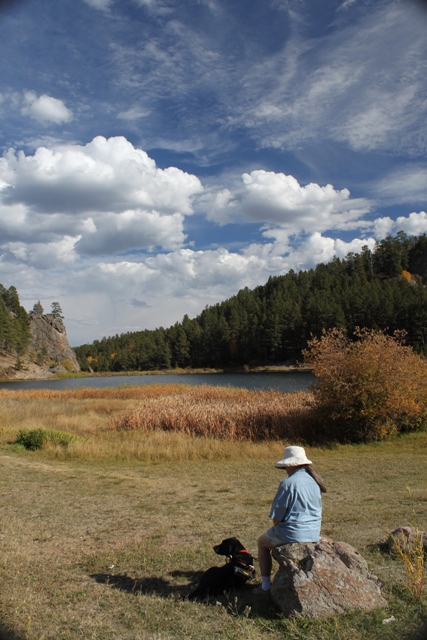
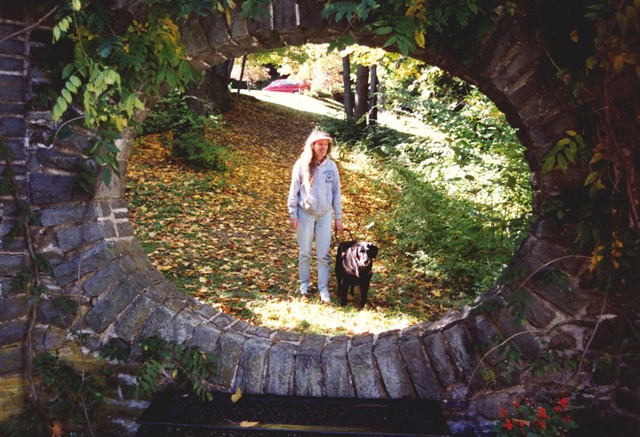
Donna & Hunter rest by a lake in South Dakota several years ago: photo by Rich Hill.

Our Favorite Trail
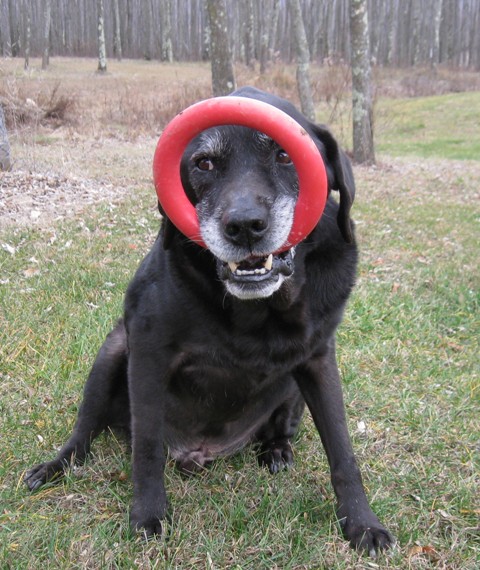
Hunter, Donna's black Lab guide dog, has found a new way to carry his red rubber Ring. It's in his mouth but flipped up over his face: photo by Rich Hill
Hunter finds a new way to carry his red rubber ring — flipped up over his face: photo by Rich Hill.

I’m currently paired with my fourth guide dog, a male black Lab,. All were trained by the Guide Dog Foundation for the Blind in Smithtown, New York. Hunter is almost thirteen and is semi-retired. Semi-retirement for Hunter is dressing up like a guide dog and accompanying his Daddy and me to restaurants, stores and parks, as well as taking me for modest rural walks, when he wants to.

To get to our favorite trail, we start by walking to the opening in an ancient stone wall. We cross between stone pillars into an area which belongs partly to us and partly to our neighbor. It loops up and down gentle hills, passing another neighbor’s fence and a steeper trail leading to the stream and woods. It’s a sanctuary, a sacred place to me.

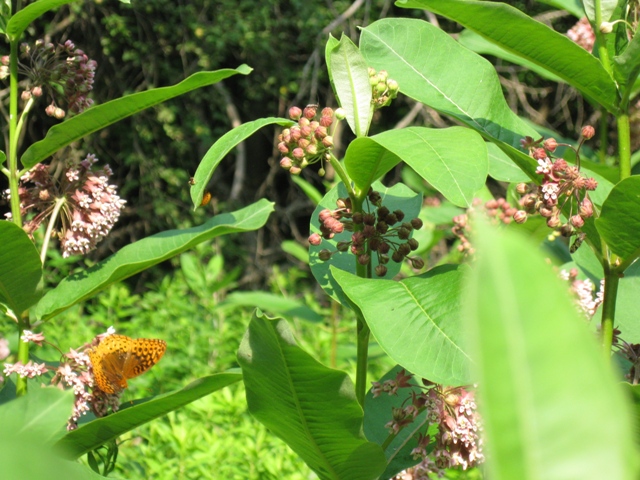
Blue Butterfly on Milkweed: photo by Rich Hill WL
Blue butterfly on milkweed: photo by Rich Hill.

My husband, Rich, developed and now maintains this trail, which I can walk in eight minutes, if I don’t stop to appreciate it. It’s a wide mowed swath through a jungle of berry thickets, bergamot, native grasses, wild flowers and enough trees to provide a cooling canopy in summer and a sea of dried leaves in the fall.
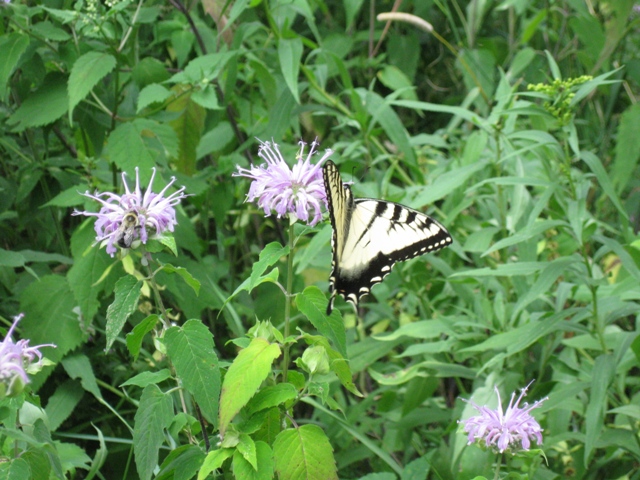
Butterfly on Bergamott in Pennsylvania's Endless Mountains: photo by Rich Hill.
Butterfly on Bergamott along our trail: photo by Rich Hill

At the time, we were enduring our warmest December ever. Since the leaves had long since fallen and the last mowing pulverized most of them into dust, the slowly dying grass was about the only thing under foot.

Something Hampers Our Journey

Hunter loves this trail as much as I do. He had been fervently lobbying me to allow him to escort me along it ever since I had placed a moratorium on these walks in November. The reason for the moratorium? Deer ticks. These tiny demons carry Lyme disease and have wreaked havoc on our family. Both Rich and Hunter have been treated for it multiple times.
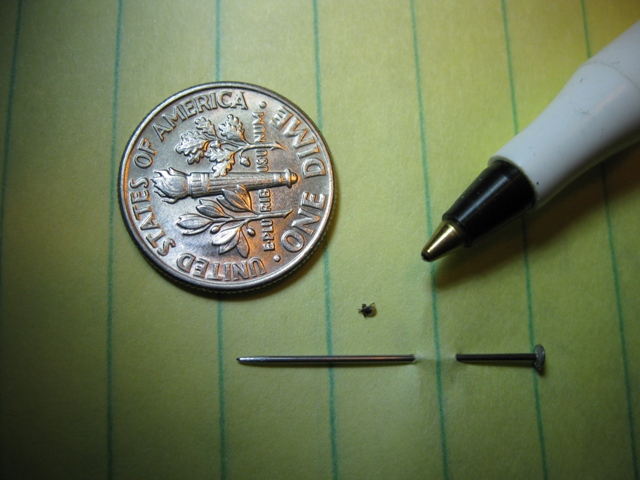
This deer tick, shown with straight pin, dime and ballpoint Pen, is huge compared to some we've found: photo by Rich Hill.
This deer tick, shown with a straight pin, a dime and a ballpoint Pen, is huge compared to some we’ve found: photo by Rich Hill

Late fall is one of the worst times for them. Once we’ve had nighttime temps below freezing, they are motivated to find a host before the hard frost puts an end to their looking. That hard frost, however, was very late in coming this year. But, Hunter hadn’t had a tick in a couple of weeks, so I decided to chance it.

Hunter Stops, But Why?

The walk was a welcomed break from my endless hours of tedious work on the computer, trying to find teachers interested in using The Heart of Applebutter Hill, my educator-recommended novel in their classrooms to promote diversity and inclusion. Chico Dees, nuthatches and crows broke the silence, as we breathed in the sweet air.

About half way around the trail, Hunter pulled hard to the left and stopped. I, of course, stopped as well. This is often a sign that he needs to relieve himself, but that wasn’t it. It’s also possible that he just wanted to indulge his “God-given right to sniff.”

After eleven-plus years of loyal service and considering the tough year he’s been through with his recently diagnosed LPE (Lymphocytic-Plasmacytic Enteritis), I’ve become rather lenient about this diversion from his job. But, he wasn’t sniffing … at least not until I just stood there for a while. Even then, it was half-hearted, as was his move forward when I gave the command. In fact, it was actually a move sideways in front of me.

The Revelation

This silent but unmistakable message got my attention. He was blocking me. At long last, I considered the possibility that he might be trying to tell me something. What a concept. I finally did what every guide dog user is taught to do, what I should have done to begin with … I checked.

This process starts with the foot and then, if nothing is obvious at ground level, the arm joins the fun, searching for low-hanging branches or — in town — street signs. As my right foot swept the area, it encountered what I immediately recognized as wood.

“Good boy!”

Picking Up the Pieces

Several storms had blown through since we’d last walked the trail, and they generally leave a scattering of broken limbs in their wake. After over fifteen years, I apparently haven’t plugged that in. Stooping to investigate, I lifted the unwieldy branches, along with a gaggle of shorter sticks and tossed them off the trail.
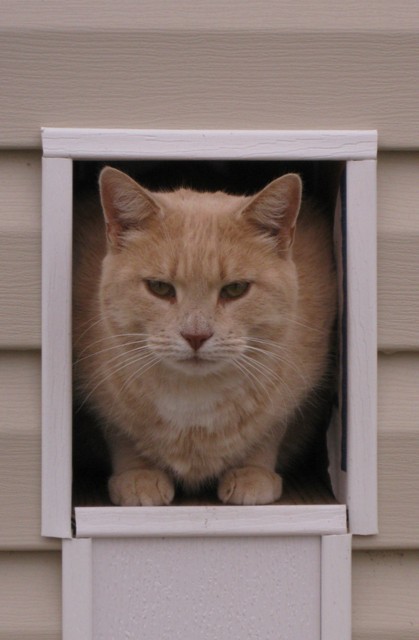
Hills' strawberry blond tabby cat Goofus, as he surveys his domain from his perch outside the new cat door in Hills' closed-in back porch: photo by Rich Hill.

As we resumed our walk, Hunter responded to my continued praise with a hearty wag and an exasperated sigh. Meanwhile, back at the ranch, Goofus marvels, “Humans … honestly.”

Posted in authors, Blindness, Dogs, Guide dogs, nature, Pennsylvania, Rural Life, Uncategorized, Visually Impaired, Wrighting | Tagged , , , , , , , | 5 Comments

Web Accessibility for Blind Americans: Obama’s Broken Promise

Most Americans take the internet for granted. Banking, accessing medical records, making reservations, shopping and school/work-related research are routinely done online. Blind Americans, however, who rely on text-to-speech software (aka screen readers) are being left behind. And, why? The technology to fix this problem has been here for years. Inaccessibility even prevents them from raising their voices about it.

Web Accessibility: Academic Research Illuminates the Problem

Graphic created by Stephanie V. McCoy @BoldBlindBeauty from a quote from Donna W. Hill. (Image - quoted text in white against a black background with a blurred image of the word WEB). The quote is: “The technology to make websites, software and digital interfaces accessible to blind people is here. ...designers use it or fail to do so at their own discretion. This leaves blind people at a significant disadvantage at school, in the job market and in the marketplace.”

In 2011, Dr. Brian Wentz (Professor of Management Information Systems at Shippensburg University), published an academic study concluding that fully 80% of the internet is inaccessible. In Wentz’s 2016 study on banking/financial sites and apps, he discovered that the problem is so bad that alarming numbers of blind people pay hefty sums for help. Find his published research at: http://www.bwentz.com/

Web inaccessibility comes in many forms. Some sites simply don’t work, often crashing screen reader software and requiring a system re-boot.

Other times, islands of inaccessibility make it impossible to interact with a site. A “Send” button won’t work, checking a checkbox will cause the screen reader to be thrown out of focus, leaving the checkbox unchecked. Sites using linked graphics don’t have alt tags explaining what they are, so the screen reader reads gibberish. Often, crucial features aren’t labeled at all. Even government sites and representatives’ “Contact” forms present problems.

Digital Access vs. Physical Access: an Analogy

Digital accessibility is to blind people what access to brick and mortar buildings is to people with physical disabilities. When the Americans with Disabilities Act (ADA) was passed, however, the internet was in its infancy. There was no Amazon, no Facebook and no Google.

When someone wishes to build a shopping mall, hospital, library or apartment complex, they must include wheelchair ramps, elevators and accessible bathrooms. Plans not addressing these issues don’t make it off the drawing board.

There is a massive difference in cost between these real-world accessibility accommodations and the considerably cheaper implementation of the “virtual ramps” of 1s and 0s necessary to connect each website to the text-to-speech software that blind people need in order to use digital devices like computers and cellphones. Nonetheless, there is no similar set of regulations ensuring equal digital access.

Obama’s Broken Promise

In 2010, for the twentieth anniversary of the ADA, the US Department of Justice (DOJ), released an Advance Notice of Proposed Rulemaking (ANPRM). It addressed the obligation of public accommodations to provide websites that are accessible to individuals with disabilities. Blind people and those with low vision are not the only ones impacted by this problem. Those with learning, sensory and physical disabilities that inhibit their use of the mouse and monitor, also rely on assistive technology and have similar access issues.

President Obama, who called these proposed rules, “the most important updates to the ADA since its original enactment,” promised to release the regulations necessary to achieve a level playing field by 2012. He didn’t. In fact, he recently pushed the date back to 2018. He has effectively washed his hands of the matter, leaving blind Americans to start from scratch with a new administration.

New Approach

In January, blind people decided to try yet another approach — a Whitehouse petition. Gabe Cazares, Government Affairs Specialist for the advocacy, training and research nonprofit National Federation of the Blind (NFB), posted the petition. As per the rules, if 100,000 people sign in a month, the President must address the issue. Until Feb. 11, it’s at: https://petitions.whitehouse.gov/petition/direct-us-department-justice-promptly-release-ada-internet-regulations

100,000 isn’t that many signatures for most of the major minorities, but for a low-incidence minority like blindness, it’s monumental. Add to that the fact that the petition is only marginally accessible to people using screen readers, and you can see that a Herculean effort has been necessary. Some, who have been advocating for accessibility for years, feel more like Sisyphus.

Press Coverage So Far is Limited

The effort has caught the attention of only a tiny group of mainstream publications. On Feb. 4, Washington, D.C.’s The Hill published an op ed by NFB President Mark Riccobono, “Inequality & Indifference.” http://thehill.com/blogs/congress-blog/civil-rights/266943-inequality-and-indifference

On Feb. 2, in the print edition of the Wilkes-Barre Times-Leader, features writer Mary Therese Biebel wrote an article “Web Changes Lose Sight of Some Users: The Visually Impaired Seek Change in Regulations.” A version appears online at : http://timesleader.com/features/508443/advocate-for-the-blind-donna-hill-of-meshoppen-asks-people-to-sign-petition-regarding-internet-access

On the same day, psychologist Dr. Nancy O’Reilly of Women Connect4Good published “Sign The Petition And Guarantee Access For All!” http://www.drnancyoreilly.com/sign-the-petition-and-guarantee-access-for-all/

Back on 1/22/16, I published “An Author’s Life Without Accessible Websites & an Easy Fix: Sign This Petition to Wake Up Obama” at: https://donnawhill.com/2016/01/22/life-without-accessible-websites-and-easy-fix-sign-petition-wake-up-obama/

Final Thoughts

I hate to be a pessimist, but with less than 4,000 signatures at this point, it’s hard to conceive of a situation developing in which we get the required 100,000 signatures. Nevertheless, to my fellow Americans, I encourage you to sign, write to, or call your federal representatives and share this information with your family, friends, co-workers and local papers. We are striving for independence, but we do need your help on this. Let the government know that you consider us equals. Sign now, if you haven’t already, and thank you. https://petitions.whitehouse.gov/petition/direct-us-department-justice-promptly-release-ada-internet-regulations

Posted in Accessibility, ADA, Blindness, Disability, Print Disabilities, Uncategorized, Visually Impaired | Tagged , , , , , , , , , , , , | Leave a comment

The Challenger’s Challenge: 30 Years Later, a Street Performer turned Author Remembers

Challenger Debris field from PhotoPin

Six weeks before the Challenger catastrophe (1/28/86), I bought my first home. I moved from Philadelphia’s Germantown section, where I’d spent eleven years as an apartment-dweller, into the magically wonderful, Montgomery County neighborhood of Glenside. Rich, my soon-to-be-husband, and I had always been space program buffs. He had helped design batteries for space missions like the Jupiter probe. Even those who didn’t routinely follow the shuttle missions, however, were captivated by the idea of lessons from space.

A Streetsinger’s Day

Donna & Curly Connor: photo by Rich Hill.

This picture of me with Curly Connor, my black, Golden-Lab guide dog, was taken by Rich Hill at Grey Towers Historical Site in Milford, Pennsylvaniaa. I couldn’t find one of us performing downtown.

On the day of the mission, I did what I did at least three times a week. I donned my heavy back pack — filled with water, rugs and sweats for my dog and copies of my first recording, Rainbow Colors on LP and cassette. After a twelve minute walk, we boarded the train in Glenside and got off in Philadelphia’s Suburban Station. My guide dog, Curly Connor, guided me to Rizzo’s Pizza Restaurant in the below-street-level corridor between 15th and 16th and Market.

The manager, an amateur boxer named Ray, brought my guitar out from where they kindly stored it for me, and I trudged off to my “spot” in the concourse to set up for six hours of performing. It was what I did. From 1978 through 1990, I was a street performer.During the summer, I sang at Penn’s Landing, near the U.S.S. Olympia and the WWII sub, the Becuna.

It was a physically challenging way to make a living. I played and sang for about three hours, took a break for lunch and played for three more hours, dropped off my guitar at Rizzo’s and took the train home. I had given up sugar and caffeine and was probably in the best shape of my life.

How I Learned of the Challenger Disaster

Sometimes, I visited schools and did assemblies about my guide dog. This ongoing connection with the education profession and young people made me even more interested in Christa McAuliffe, the New Hampshire teacher who had won a nationwide contest to fly as a civilian, much to the delight of the kids around the country who would be allowed to watch the launch in school.

I, however, had to work, and didn’t have time to glue myself to the TV. So, I went downtown, as usual. But, it quickly became apparent that something was wrong. People were much too quiet.

I finally asked a woman who had stopped to drop a few coins in my guitar case, and she told me the Challenger had exploded. I packed up at once and went home, feeling guilty for standing there and singing and not having known.

Later that day, after listening to President Reagan’s speech to the nation, I wrote the following song. The Sound Cloud audio player is after the lyrics.

Lyrics: The Challenger’s Challenge – Words and Music by Donna (Weiss) Hill

Verse 1:
The skies were blue over Florida,
The shuttle had nicely cleared the tower
Our heartfelt pride, we couldn’t hide
so much was riding on that hour.

A school teacher from New Hampshire,
A Hawaiian engineer,
Lessons from space, the Spartan Halley comet-chaser,
Who could know the end was so near?

Bridge 1:
In a fiery blast, it happened so fast
In a harsh reality
We saw their lives and dreams, in fragments and streams
Scattered on the deep blue sea.

Chorus:
The future belongs to the brave,
The faint hearted fall by the way
With hard work and prayer
we’ll get there, we’ll get there,
Take the Challenger’s challenge every day.

Verse 2:
Our hearts are blue in America,
For our seven heroes and their kin,
We wonder why they had to die,
And dare we ever take that chance again?

Francis, Michael, Ellison,
Christa, J.R., Greg and Ron,
Captain and crew, we love all of you,
And your courage will help us go on.

Bridge 2:
Someone had to challenge the ocean, someone had to challenge the sky,
So we’ll cry our tears, but not allow our fears
To let the Spirit of the Challenger die.

Chorus:
The future belongs to the brave,
The faint hearted fall by the way
With hard work and prayer,
we’ll get there, we’ll get there,
Take the Challenger’s challenge every day.

Listen to The Challenger’s Challenge

For More Information About the Challenger

“Space shuttle Challenger’s final voyage is remembered, 30 years later” – CBS News
by veterin space program journalist William Harwood http://www.cbsnews.com/news/30-years-later-challengers-final-voyage-remembered/

Also, the December, 2016 issue of Popular Mechanics has a great article. I can’t find it free online, so go pester your favorite mechanic.

Challenger Photo Attribution

Challenger via photopin All rights reserved by the author

Posted in authors, memoir, songwriting, Uncategorized | Tagged , , , , , , , | 5 Comments

An Author’s Life Without Accessible Websites and an Easy Fix: Sign This Petition to Wake Up Obama

I just spent two-plus hours composing the following tech-support email to LinkedIn Customer Experience Advocate, Carina. It demonstrates, if you can stand to read it, why blind people need President Obama to release regulations for web accessibility. These regulations are necessary because the Americans with Disabilities Act (ADA) was signed into law three years too early to fully cover the major accessibility issue facing blind Americans today — digital access. BTW, this is my fourth letter to Linked In since December. As an example, it doesn’t even come close to representing the worst of the problems.

Donna's black Lab guide dog Hunter watches from his bed, as his Mom writes stuff like this instead of paying attention to him: photo by Rich Hill.

Hunter, my black Lab guide dog, spent this time wishing I’d pay attention to him instead of writing this stuff. This photo, by my hubby Rich Hill, shows him looking out from his bed.

The technology to make websites, software and digital interfaces accessible to blind people is here. It’s been here for decades. There are even free resources to help companies provide accessible websites. The problem is that designers use it or fail to do so at their own discretion. This leaves blind people at a significant disadvantage at school, in the job market and in the marketplace. Thus, unemployment, poverty and isolation persist for blind Americans. President Obama promised to release these regs by 2010. Make him keep that promise, even if it’s six years late.

What do you believe? Should people like me have the right to live independently, without having to share our personal financial and medical information with strangers? Should we have the right to pursue our career and personal goals without having to take time out to compose letters like this one? If you believe we should, please sign this petition and get others to do so, ASAP. The deadline is February 11th.

You have to enter your first and last name, email and zip code, and then click on an email verification that they will send you. It, unlike composing this letter, really does just take a minute. https://petitions.whitehouse.gov/petition/direct-us-department-justice-promptly-release-ada-internet-regulations

Background

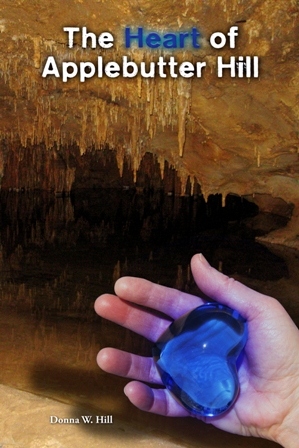
Goofus, a strawberry blonde tabby gets cozy with a paperback copy of The Heart of Applebutter Hill by his Mom, Donna W. Hill. The cover shows a cave scene with a hand holding the blue Heartstone of Arden-Goth: photo by Rich Hill.

Another Rich Hill photo shows our strawberry-blond kitty Goofus with a copy of The Heart of Applebutter Hill.

I use LinkedIn to establish contacts with people who might have a special interest in my novel, The Heart of Applebutter Hill, which I am using to promote diversity, anti-bullying and the full inclusion of people with vision loss and other disabilities. I am blind and live in a rural area and using the computer is the easiest, cheapest and – considering that I can’t drive – most available way to further my goals. Linked In provides me access to professionals in the fields of education, rehabilitation and advocacy that I could spend days and still never find through Google searches. I have close to 2,000 connections, some of which have led to references, reviews, recommendations and even speaking engagements.

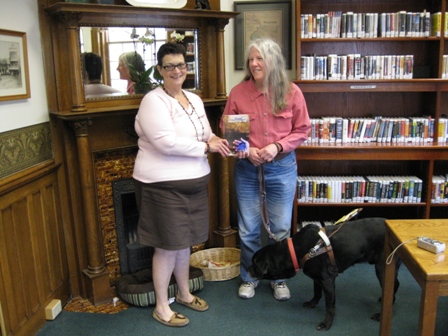
Donna W. Hill donates educator-recommended novel The Heart of Applebutter Hill to Wyalusing Library Dir. Cathy Brady: photo by Rich Hill.

This is me donating The Heart of Applebutter Hill to Wyalusing Library Dir. Cathy Brady: photo by Rich Hill.

LinkedIn is an example of one of the many sites that are partially accessible. I can do some things, but not others. It is important for me to try to get the most out of this professional networking site.

It was my need to keep track of all of those connections that started this whole conversation. I like to do that offline in my Outlook email program, organizing the acceptance emails by categories of professions and locations. This was going along great for years, until December, when I started noticing bulk acceptance emails. Sometimes ten people were mentioned in one email. This makes it difficult, to say the least, to continue with my organization of new connections. So, I wrote asking if there was a setting to change this back to individual emails.

Alas, there wasn’t, and it has nothing to do with accessibility, just an unfortunate whim of LinkedIn. However, I had mentioned other issues which are accessibility issues, and those are discussed below.

Letter to Linked In from Blind Writer

Hi Carina,

Thanks for getting back to me and for the explanation about the multiple acceptance emails. It seems like they just started doing it, because with all of the connections I have, I never received one of the bulk acceptance emails until a month or so ago. I hope they will change that sometime and send an individual email for each new connection like they did for years.

Here are the answers to the other issues you addressed. If I am not mistaken, they are all issues for your accessibility team and involve proper coding of LI pages to work accurately with text-to-speech technology (i.e. screen readers). Just because something is clear to the sighted mouse user, doesn’t mean the page will work for blind people and others using adaptive technology.

1.

Donna:

BTW, problems with the People You May Know page, which turns up when you accept an invitation via the notification email, still persist. My screen reader is unable to stop repeating that I am now connected with so & so, and the “Close” button under that message doesn’t work with Jaws 14 through 16. This makes it tedious to use the page, because what I am reading is interrupted so frequently with this announcement.

Carina:

To be sure I understand this issue, when you accept an invitation you’re still seeing a notification when you login in that you have an invite?

Explanation:
No. When I click on the “Accept” link in the email, the acceptance is confirmed online. There is no further “Invite” for that person online from that point. The message says, “You are now connected with so and so.”

The problem is that my screen reader, which speaks the words on the screen, repeats this message every 15 seconds or so, even when I am nowhere near the message on the page. I can be directing the screen reader to read something else entirely, and whatever I’m reading is automatically interrupted by this message, over and over again. I have to stop, refocus the screen reader and try again and again to get it straight. Also, it is very difficult to even find this message on the page, and when I do, I cannot close it. There is a “Close” button, but it does not work, ever. I believe this is an instance of incomplete accessibility coding by whomever sets up your site. Jaws recognizes that there is a button, but can’t interact with it.

2.
Donna:

Many of the suggestions I pass over keep re-appearing. Is there anything being done to correct this?

Carina:

I’m sorry for this issue, the next time you see a suggestion of someone you’ve already ‘x’-ed out please provide their first and last name and a link to their URL link.

Explanation:
This is not quite what’s going on. When I say “passed over,” I mean that literally. As I mentioned in my initial inquiry, I am not able to dismiss most of the suggestions on the “People You May Know” page. Sometimes, there’s a button labeled “dismiss” but usually (at least 90 percent of the time, no such option is available … at least for screen reader users such as myself. If the option to dismiss is there for sighted readers for all suggested connections, you need to alert your webmaster to the fact that the buttons are apparently not properly labeled to work with screen readers such as Jaws.

3.
There is another labeling issue which is confusing with regard to some of the suggestions on the “People You May Know,” page, which you did not address in your reply. My original comments on this, which I think are what prompted you to suggest cancelling my invitations (something I do not want), were:

Donna:

I know I have accidentally invited people. I think whatever you’re doing when you have a secondary contact listed under a name is very confusing. I’m guessing that, in those cases, the invitation goes not to the person you are inviting but to the secondary contact to pass along or something? The button repeats the name you want to connect with, but after you enter on it, you hear the name of the other person listed first.

Explanation:

I want to clarify this point. For screen reader users, we hear the name of the person and whatever they’ve listed as their occupation. Below that (and that’s how it appears to us, even if it’s not lined up that way for sighted users), there are 3 buttons. Usually, the first two are labeled identically, and the third is “Invite.” For instance:

John Jones
Assistive technology specialist
43 connections in common with John Jones button
Connect with John Jones button

I don’t know what the first two buttons do. Perhaps, they open something giving you the names of the connections. Why there are two identical buttons, I don’t know, and I’ve never had the nerve to “go exploring.”

When I press the Connect with button in this case, I hear a message, “Alert, an invitation has been sent to John Jones.”

This is fine and, despite the unclear nature of the two identical buttons, I get what I want.

Then, there are the other suggestions. These differ from the example above in two ways. First (and with my screen reader constantly repeating the message discussed in #1 it took me a while to notice this), the first two buttons are not the same. What I hear goes like this.

Jane Smith
Teacher of the Visually Impaired
40 connections in common with Albert Brown button
15 connections in common with Jane Smith button
Connect with Jane Smith button

In this case, if I click on Connect with Jane Smith, I receive the message, “Alert, invitation sent to Albert Brown.”

Why is the invitation going to Albert Brown and not Jane Smith? Is Albert supposed to forward it to her? I’m left wondering who has connections in common with whom here? Perhaps I don’t have any connections in common with Jane, but nowhere does it say.

4.
I also asked about your accessibility person Jennison Asuncion, who used to field questions about accessibility for blind people and others using adaptive technology. Webmasters must code their pages properly to make these adaptive technologies work, and it is important for someone who has some understanding of accessibility issues to be interacting with them. Is he still there? Has someone else replaced him?

5.
Also, on the LI Contact us form there is a drop-down to choose the subject of the inquiry. Accessibility is not one of the choices. That’s why I chose “Other.” Kindly request that LI include “Accessibility issues for people with disabilities” as a choice. I think this would make your job easier.
Thanks,
Donna

Thank You

Please, please sign the petition and share this with your friends and connections. Again, it’s https://petitions.whitehouse.gov/petition/direct-us-department-justice-promptly-release-ada-internet-regulations

Posted in Accessibility, ADA, Blindness, Uncategorized, Wrighting | Tagged , , , , , | 6 Comments

Hunter with ring over his nose

Well, I didn’t mean to post this, just to add it to my library. But, now that it’s here … Hunter figured out a new way to carry his red rubber ring.

Posted in Dogs, Guide dogs, Uncategorized | Tagged , | 1 Comment

Featured Book: The Heart of Applebutter Hill by Donna W. Hill

Many thanks to poet and author Denise N. Fyffe for featuring my YA novel on The Island Journal.

Jamaica Pen Editor's avatarJamaica Pen Publishers

The Heart of Applebutter Hill

The Heart of Applebutter Hill book The Heart of Applebutter Hill book

14-year-old Adiaphoran refugees Baggy and Abigail are a bit cynical, as they are alone in a new country. Rounded up with other refugee kids, they live in Transition House at the Plumkettle Learning Center until they are placed with guardians. Photographer Baggy moves into a berm house containing a WWII periscope with the secretive Captain Sodpeg. Abigail, who is losing her sight, gets a guide dog and is finally invited to live in the carriage house behind Mrs. Plumkettle’s on Old Applebutter Hill Rd.

Join Baggy, Abigail and Curly Connor as they fly the Cloud Scooper, sneak around Bar Gundoom Castle and row across an underground lake. Their lives change instantly, when they uncover a secret. The powerful and dangerous Heartstone of Arden-Goth, a heart-shaped sapphire, is hidden in Applebutter Hill, and corporate giants place a spy at their…

View original post 688 more words

Posted in adventure-mystery, authors, Blindness, Disability, Dogs, Education, fantasy, Guide dogs, novel, Print Disabilities, Uncategorized, Visually Impaired, young adult | Tagged , , , , , | 5 Comments

Writing: the What & Why of It

The written word permeates all aspects of our lives. Even if we exclude books, newspapers and magazines, our world is filled with documents of identification and ownership, insurance policies, medical records, instructions and warnings. The written word is etched into our sunglasses, emblazoned across our food and stamped on our underwear. It’s so ubiquitous, in fact, that we rarely spare a thought for what a marvel it is.

What is Writing?

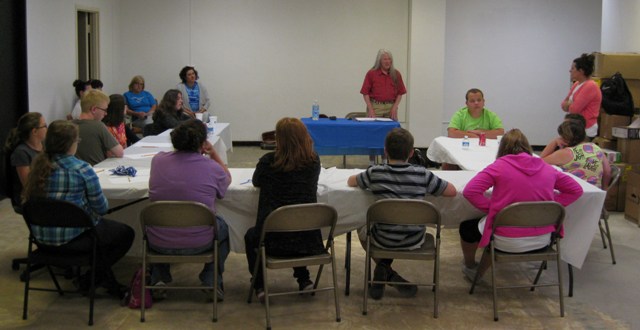
Donna W. Hill in Hazleton, PA from Behind Group of Kids: photo  by Rich Hill.

Donna speaks about writing to a group of teens at Community Services for Sight in Hazleton, PA.

The ability to collect and organize thoughts, observations and opinions and to encode them in a format that others can access long after we’re gone is the crowning achievement of the human race. It wasn’t always this way. People have been trying to communicate all along. Before the development of language, we used the “point, grunt and shove” method. It had its place, but it couldn’t keep up with the complexities swirling through our primitive brains.

Eventually, humans developed the spoken word. By using vocalizations, we could convey concepts that were far more subtle than what we could communicate through grunts and gestures. Yesterday, tomorrow, forever, nowhere, nothing, created nuances in our communications that further expanded our thoughts and imaginations.

The written word took things to a whole new level. By assigning little squiggles and lines to represent different sounds, we were able to make a lasting record of our thoughts. Everything we have achieved in science, technology, medicine, literature, music and so on owes its existence to the ability to write things down.

Sometimes when I say this, someone reminds me that we don’t need to write things down, because we can make videos of ourselves speaking, and those videos will live on after us.

First, we can be more precise in writing. Flubs, incomplete thoughts and errors are far easier to edit in written form. But let’s set that argument aside. Consider something we know from history. Simply put, we would have never developed the ability to record audio and video if not for the written word.

So many people living in different places and at different times contributed parts of the puzzle – math, science and technology. It was the ability of those who came after them – made possible by the nature of the written word – to read their thoughts and put things together, that enabled the discoveries and inventions that enrich our lives today.

Why do people write?

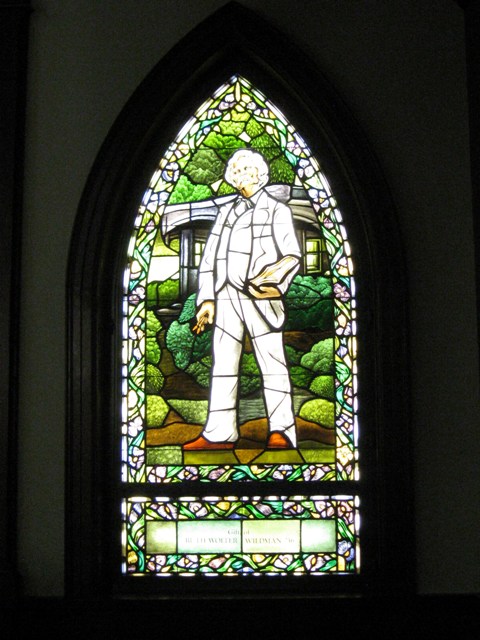
Mark Twain Stained Glass Window at Elmira College: photo  by Rich Hill.

Some writers like American humorist Mark Twain get their own stained glass windows.

When we think of writers, we think of novelists, journalists, poets, playwrights and songwriters. These professionals, however, are merely the tip of the iceberg.

Writing is something people do for many reasons. Some write to entertain, to educate, to inform, to sell and even to deceive. As beings who have developed language as a way to communicate and the written word as a way to record that communication, we have an innate connection to the art and craft of writing. It is nothing less than our birthright as human beings.

Why Should You Write?

Why? First of all, because everyone has a unique, irreplaceable vantage point to observe the world. Each of us has something to contribute to the discussions around us, both minor and monumental. No one – not today or in the future – will ever be able to capture your point of view … no one but you.

Secondly, it’s your best tool for self-advancement. The ability to clearly express your opinions and observations is the pinnacle of literacy. Communicating with others enables us to resolve conflicts, make new discoveries, solve problems and elevate ourselves in the minds of those who are in a position to help us grow and achieve.

The people who provide the texts of our news and entertainment may be the most well-known of the writers among us, but they are by no means the only ones. Writing is an essential skill in many professions and a skill that can elevate you above your peers when you develop a level of comfort and proficiency in using it.

Even if you have no thought of ever being published, of ever writing the great American novel or being the next J.K. Rowling, Stephen King or J.R.R. Tolkien, the skills you develop when you write will give you a leg up in life. Knowing how to express the thoughts you have in ways that will be accurate and inspiring can help you elevate the thinking of others on any topic you choose. When you do that, people notice.

Getting Started with Writing Your World

Allow writing to become a regular part of your life. Remember that, like everything else, it’s a skill that needs to be developed through practice. You’re going to hit a few sour notes. You might walk into a wall. You might put too much salt in the soup. The important thing is to start somewhere and work on it.

One of the best things you can do to get started is to keep a journal. Write something every day. Write what happened and what didn’t happen. Pick something and describe it as though you were talking to someone who was going to experience it only through your words.

Capture a bit of the dialog of your life by precisely quoting something someone said, complete with the misspeaks, slurred words and hesitations you hear in the world around you. Did you hear anything that puzzled or alarmed you? Did something strike you as funny? Write it down. It’s your journal; you don’t have to share it, edit it or even re-read it, but keep it and enjoy the process. You’ll be glad you did.

Posted in authors, Education, Literacy, Uncategorized, Wrighting, Writing Process | Tagged , , , , , | 3 Comments

Writer’s Rant: Unchain Me from This PC!

Hope springs eternal … at least until it is dashed on the rocks of reality. Whether it’s a month, a year or a decade, perceptions of that perfect house, job, community or relationship can switch from a beautiful thing to a pile of garbage. I’ve had my share of dashed hopes, but rarely if ever, have I experienced the whole process in less than five minutes. Even a disappointing meal takes longer to be served than what happened last week.

An Author’s Dream

6 Petal Lilly Flower: photo by Rich Hill

I have an HP Pavilion PC running Windows 7. Come on, you knew this was about computers, right? I also have this image of myself sitting by the pond, breathing in the pure mountain breeze. With the constant encouragement of my beloved frogs and birds, Heaven knows what masterpieces I could write.

Butterfly on Milkweed Flowers in Various Stages:  photo by Rich Hill

There’s more to it, though. I don’t like using the desktop in thunder storms – even with surge protection, and we get a lot of thunder. I’m also sick of traveling with a little cassette recorder to take notes on our adventures, only to spend hours transcribing them at home.

The Problem

Bee on Catnip Bloom: photo by Rich Hill.

The desktop is OK, but it doesn’t fit in my back pack. I was thinking of a tablet or a small laptop. I have to keep something else in mind when I shop, however. I’m blind, and I use a screen reader called Jaws (Freedom Scientific, St. Petersburg, Florida) to access the digital world.

Accessibility for those of us who navigate the universe nonvisually has “come a long way, Baby,” since the Americans with Disabilities Act was signed into law twenty-five years ago, but it also isn’t perfect. In relation to the internet, it also “ain’t what it used to be,” which pretty much describes my hands. I doubt seriously that I could adapt to a virtual keyboard.

Research

Strawberry Blonde Tabby with Blooming Amaryllis in Lazy Boy: photo by Rich Hill

I got a few suggestions and warnings from other blind people who have gone down this road before. Make sure it runs a full version of Windows not Windows RT (whatever that is), or you won’t be able to run your Jaws screen reader; the HP Stream 8 is on sale this week; the Dell Venue is nice; the Surface is really nice but really expensive; Apple iPads are great, but you’ll have to learn a whole new operating system and a whole new screen reader; Android has a built in screen reader, but it might not be as robust as you’re used to; and you can get a Bluetooth keyboard to use with anything.

OK, so I did some Googling. I’m a little touchy about online accessibility. Not only isn’t it what it used to be, but it also isn’t what it could be, if web designers used the free tools at their disposal to ensure that their sites worked for all users. No, there’s no enforcement for digital accessibility like the brick and mortar licensing process which ensures that buildings have wheelchair ramps, elevators and accessible bathrooms.

HP: Making Things Difficult for Blind Customers

I ended up coming away from my research with a bad impression of HP. The link to the “features” section for the Stream doesn’t work with Jaws. It seems to be a link, but the screen reader version of “clicking it” doesn’t get you anywhere. Think of knocking on a door and nobody answers.

Advocate that I am, I decided to tell HP about the problem. This is usually a waste of time, but short of literally making a federal case of it, it’s our only option. I found a handy Contact Us link. A quick perusal of the form fields brightened my spirits when I realized they weren’t going to ask me to solve any of those stupid security graphics. Jaws, like my sighted husband, doesn’t do well with security graphics.

So, away I go, filling out the form. Only problem was, the drop-down menu where you choose the subject you’ll be commenting on, isn’t accessible to Jaws. In other words, some person didn’t quite do the right series of 1s and 0s when setting up the form. Unlike me, however, that person is getting paid.

Author Lashes Out at HP

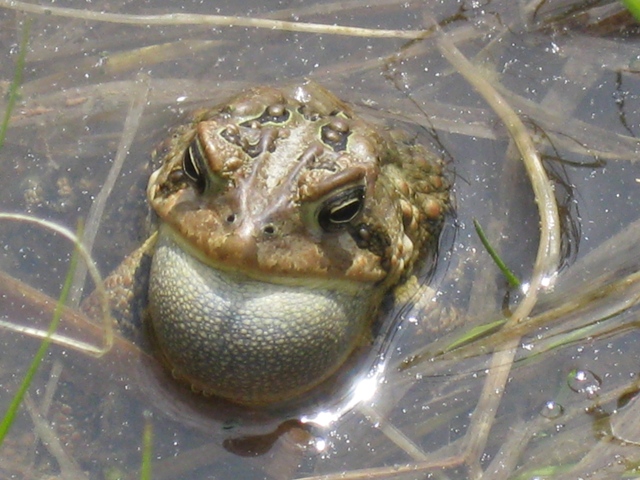
American Toad Singing: photo by Rich Hill

The subject is a required field, so without it the form couldn’t be sent. OK, now I’m angry. My only recourse at this point (if you exclude the joys of calling someone in another country) is to publically shame HP on Twitter. I found an account specifically for the Stream and sent them the following message via Tweetymail.:

Hey @HPStream8 HP’s Contact form’s subject drop-down menu is inaccessible to blind HP Pavilion user who was thinking of buying a Stream. #AT #accessibility #VisuallyImpaired

Well, how satisfying is that? I’ll probably never hear from them – usually a blessing, since when I have heard from companies in the past, they invariably run me around in circles.

HP: Redemption or Revenge

We visited several stores so I could get my hands on these things – Best Buy, H.G. Gregg and Staples. I learned that some of the tablets come with their own keyboard. My problem with these keyboards is that they have a mouse pad right where I might knock it with my ailing wrists. One salesman showed us that you can disable that, so that little road block didn’t last long.

HP almost redeemed themselves. My hubby noticed a Stream 11 at Staples with a 360 degree flexible hinge. Apparently, no matter what I had been telling myself, it’s rather important to me that this new contraption not only be small and have a keyboard, but that it be possible to tuck the display out of the way. What I really want is a keyboard with Windows 8 installed – no display. Well, that isn’t going to happen. But this 360-degree flexible hinge? You can fold the tablet and keyboard back to back.

We were over the moon! It would be just like having no display. It would be a nice little keyboard, small, flat. I could install Jaws and type away to my heart’s content.

Woops, one little problem. Folding the thing back on itself does something we hadn’t anticipated – it disables the keyboard. Yes, of course, what was I thinking. This was obviously, like so much of our digital world, not made with blind folks in mind. It’s for the sighted user who wants a keyboard for once in a while, but who mostly uses the touch pad.

But, maybe, just maybe, they have a setting to defeat the defeating of the keyboard. The sales person checked and no, that ain’t happening. What was all that clanging and clattering in my head? Oh, that’s right, it was my stupid hopes crashing to the ground.

Onward and Upward

Sooner or later, even if it isn’t quite perfect, I’ll be purchasing a small laptop or tablet complete with keyboard. Maybe not an HP, though.

Posted in Accessibility, ADA, authors, Blindness, Uncategorized, Visually Impaired, Wrighting | Tagged , , , , , , , , | 3 Comments

National Poetry Month: a Tribute from a Fictional Creative Writing Class

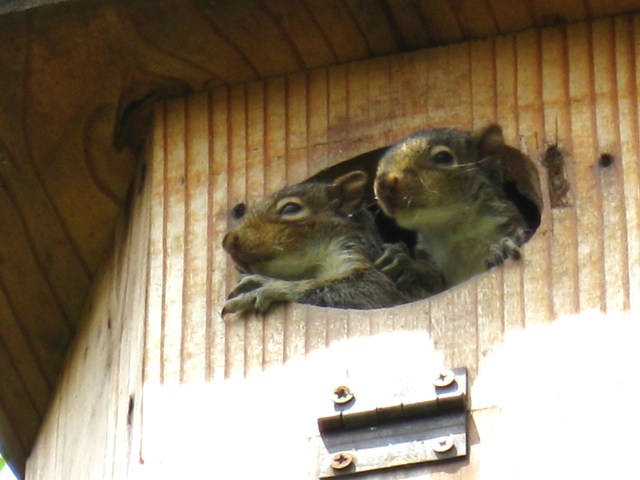
Baby Squirrels in Duck House: photo by Rich Hill
“No, you go first.”

Here’s a chapter from my novel The Heart of Applebutter Hill. It’s the first day of the summer term at the Plumkettle Learning Center. Our heroine, 14-year-old Abigail, her guide dog Curly Connor and best friend Baggy – along with 5 other students – are all refugees from the Isle of Adiaphora. The students read quotes from Wordsworth, Rushti & Plato, and you might enjoy the portrayal of a rather unconventional creative writing teacher.

Writers’ Roundtable – from The Heart of Applebutter Hill by Donna W. Hill

Second-floor-west was quiet and empty when the two friends headed for the closed door at the end of the hall. Once inside the photography department, Baggy spotted students heading into the westmost of the two conference rooms on the south wall and followed.

The long, narrow room had a round table in the center. It would have seated ten, but the chairs on either side of the teacher’s had been removed. There was a desk off to the right and a sofa on the left. Curtains blocked most of the light from the south-facing windows.

“Hey, Baggy,” said Christopher, who was standing near the sofa, “I didn’t know you were a writer.”

“I’m not,” Baggy grumbled as he approached the small boy.

“Me neither,” Christopher said with more apprehension, “They m-made me take it.”

An older boy with long dreadlocks was seated at the table on the right side closest to the front. A red-headed girl with a big smile bounded into the room.

“Hi, Les,” she said to the boy, who raised his hand slightly in acknowledgement, “I’m Gabriele,” she added turning to the others, “I’ve noticed you and your dog. He’s beautiful” — Abigail recognized her voice and accent as the girl who stuck up for Christopher in the bathroom earlier — “I’m sorry, I don’t know any of your names.”

They all introduced themselves. Abigail sat between Christopher and Baggy on the left side of the table. Gabriele hurried to the front of the room and opened the curtains.

“Oh, it’s so nice today,” she moaned, “I can’t wait to get outside.”

She was about to sit down when she noticed another student entering the class. It was Tommy.

“Good morning,” he said smiling.

Baggy was on his feet, removing the chair next to him to make room for Tom’s wheelchair. Tommy paused before moving into place to gaze into Gabriele’s green eyes.

“Did anyone ever tell you,” he said softly, “that you have gorgeous eyes?”

She blushed and finally managed to say, “I’m Gabriele and this is Lester Fields.”

She was about to introduce the others, when she stopped in mid-sentence. Abigail heard heavy booted steps and looked back.

“Hi Laurel,” said Gabriele, “We’re all just getting acquainted.”

“Excellent,” said the girl with a cheerful though mischievous smile. She was dressed in jeans and a blue work shirt, her shoulder-length brown hair tied back with a Plumkettle kerchief, “I’m Laurel Hall. I like your dog.”

After greeting Tommy, Baggy and Christopher, she sat next to Les, and the two began talking quietly.

Thornhammer arrived a few minutes late wearing his usual black jeans and shirt. He strode to the front of the room without looking at them and closed the curtains. He placed a stack of papers on the desk. Pacing back and forth, he introduced himself to the class. He did not, to Abigail’s chagrin, take attendance.

“This is Writers’ Roundtable and I am Professor Thornhammer. Mr. Fields,” he said, nodding to Les, “Miss Hall, Miss Stein, you have all been in my class before. For the rest of you” — he looked to his right unsmiling and his gaze rested on Christopher — “This course is designed not only to help you refine the craft of writing, but to help you develop a backbone about what you do write. All of you” — he looked around at each of them — “are from Adiaphora, and as such I’m assuming that you have experienced the world in a more poignant fashion than most Plumkettle students, who have come to us from more, shall we say, settled backgrounds.” After pausing to allow them to absorb this information, he resumed his pacing and continued, “Now, “Who can tell us what the first form of literature was?”

“Comic books,” whispered Baggy. Everyone heard and everyone giggled, except Thornhammer, who shot him a dirty look.

“Anyone else?” he continued.

Lester raised his hand slightly and said without waiting, “Poetry.”

“Precisely,” said Thornhammer taking his seat at the head of the table,” We traditionally begin our classes with quotes about writing from respected historical figures. Mr. Fields, if you would get us started.”

Abigail felt her heart race in anticipation of reading her own quote. She could hear Christopher squirming in his seat. Lester showed no emotion as he opened a spiral notebook.

“Yes, it would be my pleasure” he began in a strong calm voice, “This is from Preface to Lyrical Ballads by the father of the Romantic era of British poetry, William Wordsworth. ‘All good poetry is the spontaneous overflow of powerful feelings: it takes its origin from emotion recollected in tranquility.’.”

After a dramatic pause during which Abigail supposed that they were to reflect on Lester’s quote, Thornhammer called on Christopher. He fumbled with his papers and coughed before proceeding in a faint voice.

“A p-poet’s work,” he said before coughing again, “is to n-name the unnamable, to point at fr-frauds, to, to take sides, st-start arguments, shape the world, and stop it going to…to sleep.”

“By?” Thornhammer prompted.

“S-Salman ruh-Rushdie.”

“And, Miss Jones?”

Abigail’s body jerked involuntarily. She had been sidetracked by the alarming, almost militant view of poetry in Christopher’s quote.

“The ancient Greek philosopher Plato,” she said, struggling to refocus on the task at hand, “wrote, ‘Poetry comes nearer to vital truth than history.’“

“Thank you,” said Thornhammer getting to his feet and pacing, “History tells us what people did; poetry tells us how they felt about it.”

Abigail fumbled in her pack and hurriedly set her digital book player to record. What followed was a lecture on poetic forms and imagery.

“Now,” Thornhammer concluded, “for your first assignment, due next Tuesday, you will each write a poem–”

Baggy, who hated poetry, groaned. This caused Abigail and Tommy much consternation as they attempted to stifle giggles.

“I don’t care what type of poetry it is,” Thornhammer continued, “You can write us a sonnet, free verse, a limerick, a haiku…whatever form of poetry strikes your fancy. What I do care about is that it means something to you, that it doesn’t take up more than one page, and” — he paused to pick up the stack of papers from the desk — “that you avoid using” — he gestured with the papers — “any of these words.”

As Thornhammer handed out the papers, Gabriele whispered, “He has a list of words that he’s banned.”

“Take a moment to familiarize yourselves with this list. I will not tolerate the use of these words in this class, not on paper and not in conversation.”

When he reached Abigail, Thornhammer pressed a stiff card into her hand. She fumbled with it and, after getting the Braille right-side up, read, “Professor Thornhammer’s Banned Four-Letter Words.” Her heart raced in anticipation of the words he might have included, but the list was a simple one: Like, Sure, very, fine and just.

“Ooo,” said Gabriele, “there’s a new one.”

“Just?” whispered Laurel.

“For you in particular, Miss Hall,” Thornhammer replied sternly.

Abigail puzzled over the words trying to reason out why they would be banned. She understood that some kids said, “like” incessantly, but thought the word had legitimate uses and wanted to demonstrate her awareness of this fact.

“But, sir,” she began, and Thornhammer turned to face her, “Isn’t l- … I mean this first one an accepted way of introducing a simile?”

Thornhammer did not answer immediately, giving her a moment to savor the possibility that he was about to praise her.

“Not,” he said at last with heavy finality, “in this class.”

Purchase The Heart of Applebutter Hill & Help Blind Students

The Heart of Applebutter Hill book cover shows cave scene: stalactites reflected in an underground lake, while a hand holds the Heartstone of Arden-Goth, a blue, heart-shaped sapphire

Print

Amazon: http://www.amazon.com/books/dp/1483948226
CreateSpace eStore: https://www.createspace.com/4000964

eBook versions can be purchased at these and other outlets

Kindle: http://www.amazon.com/dp/B00CNG6DDM
eBook Universe: http://www.philipsmith.eu/indie-author/donna-w-hill
Nook Book: http://www.barnesandnoble.com/w/the-heart-of-applebutter-hill-donna-w-hill/1115426305?ean=2940016415000&itm=1&usri=2940016415000
Apple iTunes: https://itunes.apple.com/us/book/the-heart-of-applebutter-hill/id651693834?mt=11
Smashwords (7 eBook formats, including .epub, .mobi, .pdf and .rtf): http://www.smashwords.com/books/view/313071?ref=DonnaWHill

accessible versions are available for Readers with print disabilities

Bookshare: http://www.bookshare.org/browse/book/639304

A Request from Donna

After you’ve read The Heart of Applebutter Hill, please rate it and leave a review on the site where you purchased the book. Thank you for your interest and support.

Posted in authors, Blindness, Braille, novel, poetry, Uncategorized, Visually Impaired, Wrighting, young adult | Tagged , , , , , , , | Leave a comment

Writers’ Gazebo: Assumptions & Directions

Good writers take great pains to make their work perfect. Whether it’s an article, story, novel or the text for a marketing campaign, they check and double-check to ensure that spelling and grammar conform to current standards. They labor over their opening sentences, using powerful images and language to grab the reader’s attention ASAP. Nonetheless, it’s not uncommon to overlook the obvious. The basic problem is something done by humans in general. We make assumptions.

Simply put, sometimes — quite often, in fact — we all need to get back to basics. And, there’s nothing more basic than being clear about what you want to say, understanding that what you know may differ from what someone else knows and remembering what impact you hope your piece — written or spoken — will have on others.

Location, Location, Location

After living in Northeastern Pennsylvania for almost eighteen years, I still marvel at the assumption — rampant from the Poconos along the Delaware river and the Lehigh Valley to the coal region surrounding the Scranton, Wilkes-Barre area and the rural Endless Mountains — that everyone knows where everything is. Businesses pay good money for TV, radio and print ads extolling the virtues of their products and services without the slightest mention of their location. I fear that my regular astonishment at this may be leading to facial abnormalities.

One summer, we came across an ad for a restaurant. Examining it thoroughly, we found no street address, no mention of the town in which the place is located, or even a reference to being near any major route. There was, however, a phone number. We didn’t recognize the exchange, so I called.

“Hello, Wellingtons.”

“Hello, can you tell me where you’re located?”

It was a prophetic question. The young man answered with a confused “uh,” moved his phone arm away from his mouth and bellowed, “Hey, Bob! Where are we located?”

Bob began to bellow the directions back to his employee, but stopped abruptly with an exasperated sigh. In the time it took for Bob to come to the conclusion that he had better talk to me himself, I couldn’t help wondering how the young man got to work.

As it turns out, they are at Rt. 6 and 11 in Clarks Summit, but assigning that information to print was apparently too much to ask. In their defense, as lame of an excuse as it is, they are probably paying by the word. Here’s an idea; why not drop the name next time and save even more?

Where Something Used to be Isn’t Quite Descriptive Enough

Then, it was an ad in Wyalusing’s Rocket-Courier. We were warmly invited to the Harkness Family Restaurant. The ad explained that Harkness used to be called The Tomahawk and went on to say that it had moved and is now located where The Pepper Shaker used to be. Naturally, there was no address. The sting of my own palm is still visible on my forehead.

We did, however, notice an ironic twist; the Wyalusing Hotel, which did have the good grace to list their address, hasn’t undergone a name or location change in over a hundred years.

Our favorite “directions” story, however, happened locally and had nothing to do with advertising. We stopped to help a befuddled truck driver, who was trying to make a delivery. Unfamiliar with the area, he had inquired at the Meshoppen Post Office. He was told to make a left just past Dibble’s Hardware Store.

Half an hour later, having driven to Lawton and back trying to find Dibble’s, he was understandably frustrated. Dibble’s, we explained, was right next to the Meshoppen Post Office. It’s value as a landmark, however, decreased significantly years ago when it burned down. But, everyone knows that, right?

Writers, How are You at Giving Directions?

But, what does forgetting the address in an ad have to do with being a good writer? How does failing to recognize the diminishing value of directions based upon long-since defunct landmarks impact your ability to tell a story? Making assumptions that other people understand us is as American as Mom and apple pie.

How many times have you met someone new, only to have them launch into a monologue about “Biffy and Buddy” without the slightest effort to explain who these people — or pets or who-knows-what — are? Navigating assumptions is part of life. To some extent, we’re thrown into this world, and we have to just figure it out as we go.

Writing is similar. We just have to go along with it. We’re not going to get all the details in the first paragraph, and we don’t want the writer to beat us over the head with constant reminders and premature information.

Good writing, unlike daily life, however, has the potential of mitigating the confusion with a little heads’-up to the reader at crucial junctures. Is it obvious who is speaking, that the setting has changed or that time has passed? Is a character’s motivation clear? Did you want the reader to be surprised when the heroine pulls a gun, runs away from home or saves her archenemy’s life? Or, does it serve a greater purpose for the reader to anticipate the action? The answer will determine how much detail you give up front.

As the writer, you are giving directions to the reader. Not only are you helping them get a handle on how, when and where the story unfolds, but on the deeper motivations and issues that underlie the story. This requires, of course, that you know these facts to begin with.

Posted in authors, marketing, PR, Uncategorized, Wrighting | Tagged , , , , | 9 Comments