
In 1953, my younger brother and I were diagnosed with Retinitis Pigmentosa by Philadelphia’s internationally-renowned ophthalmologist Dr Edmund B. Spaeth. I was three and couldn’t see at night. My central vision was a heartbeat away from legal blindness. Thanks to the Foundation Fighting Blindness (established in ’71, when I graduated from college), our inherited retinal disorder was diagnosed as Leber’s Congenital Amaurosis (LCA).
My parents wanted their kids at home. We had surgery to fix our “wandering eyes.” I could see enough to read print – but only 5 letters at once. I was enrolled in Easton, Pennsylvania’s public schools, before “mainstreaming” was a thing.
As I navigated prejudice, bullying & zero training in non-visual skills, I became aware of a controversy. My first grade teacher was great, encouraging me to approach the Blackboard, which I couldn’t see from my desk.
Others believed I should be at Overbrook School for the Blind. Many thought, “If she’s going to be here with our normal children, she can do things the way they do.” I.e., no Braille, no White Cane, no Talking Books, no non-visual education. Use your eyes. Don’t feel around with your hands.
In 4th grade, I overheard two teachers say I was faking it. 70 years later, I think I know why. They saw me walk down a darkish hall to the playground. I didn’t bump into anything. But, in broad daylight, I acted like I couldn’t see. The truth? My eyes never could adjust normally to changes in light.
To say that I had problems with this is a gross understatement. As for real help? Well, not much. As the years rolled on, my vision deteriorated. The bullying increased. I had to make choices about what homework I could complete.
I’ve witnessed Decades of legislative, technological & genetic-testing advances, along with improvements in Braille literacy, allowing blind people unprecedented access to one another and to opportunities previously unavailable. Now, we stand on the precipice of returning to those horrible days, & it is breaking my heart.
The US Department of Education has canceled programs vital to the survival of blind and deafblind children. Blindness, especially in childhood, is a low-incidence disability. Future teachers of the visually impaired receive little education about it in standard special education programs. why the cancelation? Some say it didn’t fit in with the current anti Diversity Equity & Inclusion agenda.
Is a cure the only hope left?
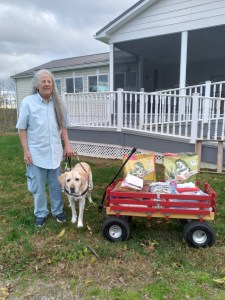
Yellow Labrador guide dog Mo leads Donna Hill (blind from early childhood) to rural bus for nondrivers. Donna (74) is pulling a 50-year-old wagon with red stake-body sides. Purina Cat Chow & other necessities are on their way to the Meshoppen Cat Rescue in Pennsylvania’s Wyoming county, in the heart of the Endless Mountains.


 The Heart of Applebutter Hill